A Hold'em preflop range fits on one 13x13 grid: 169 hand types, and you can see its shape at a glance. Omaha does not fit on a grid. PLO4 deals 270,725 starting hands, PLO5 deals 2,598,960 and PLO6 deals 20,358,520, and even grouped into hand classes there are too many to read down a list. So you ask the range a question instead.
PLO hand search is the filter box above the hand table in the RangeConverter PLO range viewer. You type a pattern, such as a rank, a suit structure, an equity band, an action label, or several of those chained together, and it returns every hand class in the range on screen that matches. The three result columns recompute for that subset: their headers show what share of the matched hands fold, call and raise, so the frequencies you read are for exactly the hands you asked about. The same syntax runs in PLO4, PLO5 and PLO6. If the viewer itself is new to you, start with the PLO Range Viewer tutorial.
You do not need the whole syntax. Four patterns cover most study: AA for a rank, $ds for a suit structure, 15% for an equity band, and :Fold (or :Call, :3.0bb) to pin an action. Everything below is the long tail for when a question needs it. The examples use PLO6 because it is the hardest case: if a pattern works on six cards it works on four. The differences for PLO4 and PLO5 are listed near the end. The syntax is the ProPokerTools (PPT) range-of-hands notation Omaha players have used in the Odds Oracle for years, with RangeConverter's additions for solver work: action filters, the triple-suited token $ts, and rank-to-suit bindings such as Az!zz.
All examples assume the SB opening spot in HU 100bb PLO6 (with limp), where the buttons are 3.0bb, Call and Fold. Swap in whatever spot you are studying.
Already fluent in the notation? Jump to the cheat sheet and come back for the details when a pattern surprises you.
Start here: five searches to run first
Open the spot, type each of these into the hand search box, and read the three column headers above the results: they give the fold, call and raise share for the hands you matched.
| Type this | You get | PLO6 hand classes matched (of 962,988) |
|---|---|---|
AA |
every hand with two or more aces | 59,976 |
$ds |
double-suited hands: two suit groups, nothing else suited | 667,186 |
AA$ds |
double-suited aces: the two filters written together | 22,245 |
9876- |
that rundown and every same-length rundown below it, down to 5432 | 43,576 |
TT-77:Fold |
the middle pairs this spot folds | depends on the spot |
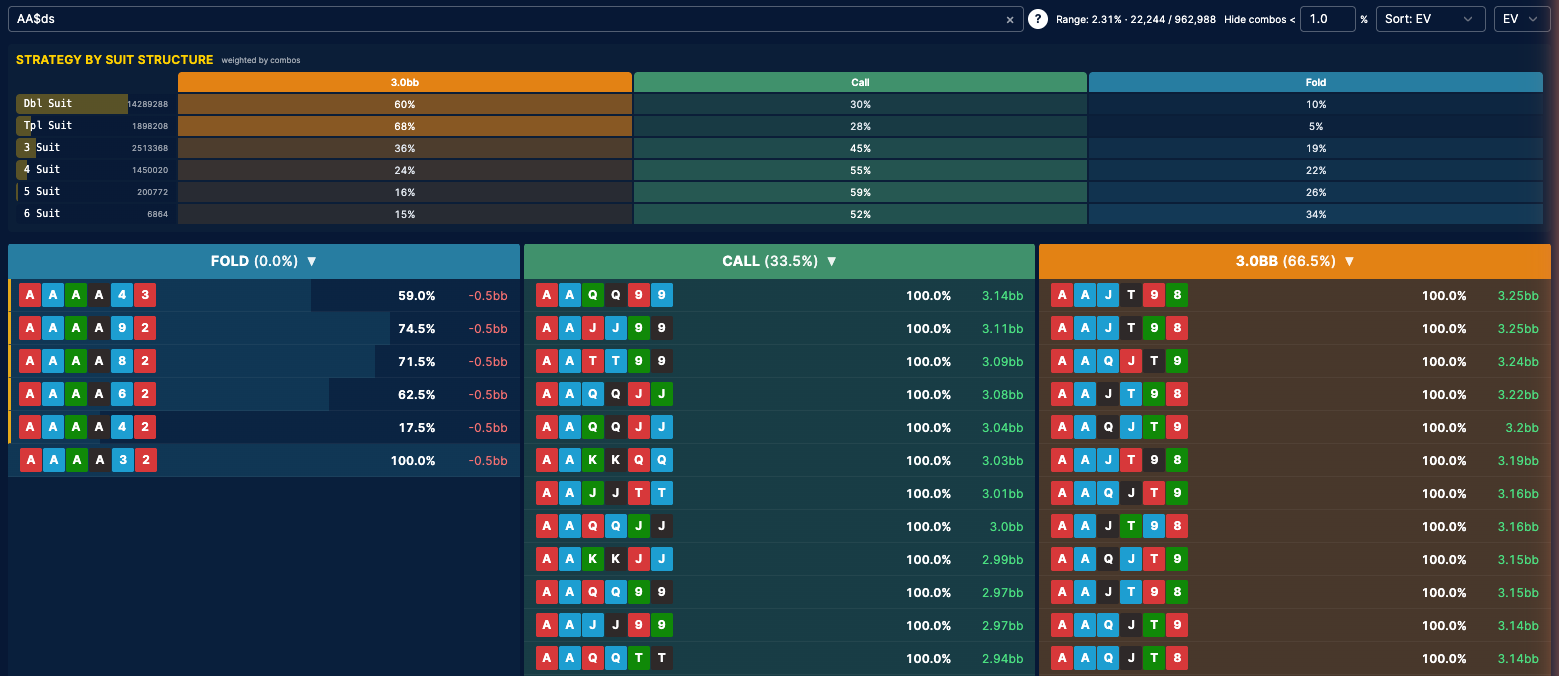
Clear the box, or type *, to get the whole range back. A search sticks while you move around the tree, so if a later spot looks thin, check the box before you check the range.
If you have used ProPokerTools, the syntax will feel familiar and what you learned there carries over. The difference is what comes back. A hand-class counter tells you how often a class wins. Here the result columns recompute for the subset you asked for, so you get the solver's action mix and EV for exactly those hands.
How PLO hand search works
Five conventions before the patterns:
- Hand class. The viewer groups hands that play identically. As-Kh-Jd-2c and Ah-Ks-Jc-2d are the same class: same ranks, same pattern of shared suits. Searches match classes, which is why no pattern can ask for hearts specifically.
- Ranks are
A K Q J T 9 8 7 6 5 4 3 2, always uppercase in this guide. Ten isT, never10. The box accepts lowercase and fixes it for you. - Suits are
hdsc, lowercase. They only carry meaning inside an explicit-card pattern such asAdJdTc7h4s3h, where they say which cards share a suit. Anywhere else a suit letter is read like a placeholder. - Placeholders
xyzwstand for "some suit", the same wildcard-suit notation as PPT. Same letter means same suit; different letters mean different suits. - Every pattern says "at least" unless it says otherwise.
AAmeans two or more aces.ssmeans at least one suited pair. The rest of the hand is unconstrained.
The operators, in one table:
| Operator | Means | Example |
|---|---|---|
| writing patterns together | AND | AA$ds, double-suited aces |
: |
AND, written out | AA:KK, aces plus kings |
, |
OR, between whole arms | AA,KK, aces or kings |
! |
NOT | A!K, an ace and no king |
( ) |
group a comma list | (AK,JT):xx, AK suited or JT suited |
[ ] |
one card slot | [T+], one card ten or higher |
$ |
a named structure | $ds, $ts, $ss, $np, $nt |
% |
a preflop-equity band | 15%, 30%-50% |
| a repeated rank | "at least this many" | AA, two or more aces |
Six words the rest of the page leans on:
- Spot: one decision point in the game tree, such as the SB's opening decision.
- Double-suited: two cards of one suit and two of another.
- Rundown: four or more ranks in a row, such as 9876.
- Dangler: a card that connects to nothing else in the hand.
- Combo: one specific dealt hand; a hand class covers many combos.
- Range: the set of hands the player can hold at the spot.
Ranks, ranges and rundowns
Single ranks and repeats
K returns every hand containing at least one king. AA returns hands with two or more aces; a repeated rank reads as "at least this many", so AAA is a set of aces in the hole and AAAA is quads.
This is the mistake new users make most: AA includes AAA and AAAA. For exactly two aces write AA!AAA (two or more, minus three or more). AA$nt also excludes hands holding three of any other rank, so in PLO5 and PLO6 it is slightly narrower.
AKQJ returns hands where all four ranks are present. In PLO6 that leaves two slots free, so AKQJ72 and AKQJT9 both match.
AA,KK returns AA hands or KK hands. The comma is OR, and it separates complete arms that can have nothing in common: [T+][T+][T+], ss is "three cards ten or higher" or "any hand with a suited pair". The comma is where most zero-result searches come from. AA, $ds returns aces or anything double-suited, which is not double-suited aces. To combine two conditions on one hand, write them next to each other (AA$ds) or join them with a colon (AA:KK).
Rank ranges: Q+, A-Q and TT-77
Q+ returns hands with at least one card queen or higher. A-Q is the same set written as a range. TT-77 returns hands containing a pair of tens, nines, eights or sevens; the pair must be a genuine pair (two or more of the rank) and the rest of the hand is open. TT-77:Fold answers "which middle pairs does the SB fold?" (the colon joins an action filter, covered below).
Rundowns and the trailing dash
9876- does more than it looks. The trailing dash means "this rundown and every rundown of the same length below it": 9876- matches 9876, 8765, 7654, 6543 and 5432, and it matches them whatever the suits do (a hand shown as 9(87)6 still hits). Length is preserved, so 987654- expands to 987654, 876543 and 765432.
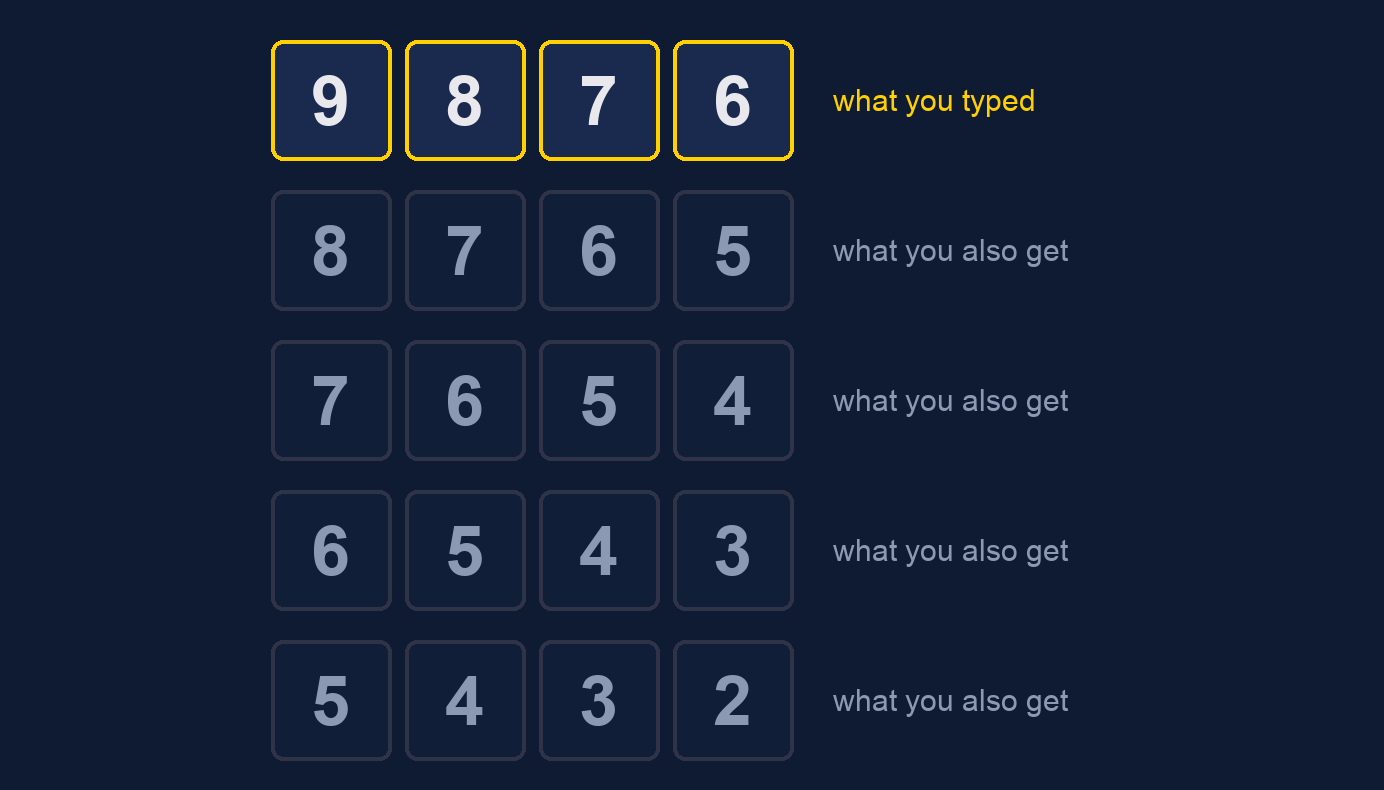
Because the pattern expands downward, JT98- already contains 9876-. To study one tier on its own, write the ranks without the dash: JT98 is any hand holding J, T, 9 and 8, whatever the other two cards are.
Brackets: one card slot at a time
A bracket describes one card slot without naming the rank. Write it twice and you have described two slots.
[A-J][2-5]77 is one card A through J, one card 2 through 5, plus a pair of sevens. Brackets count cards rather than reserve slots, which is why the example uses sevens: with 33 the [2-5] bracket would already be satisfied by the threes.
[T+][T+][T+] is three cards ten or higher. The repeated bracket is a count; add a fourth for four broadway cards.
![The PLO6 viewer after searching [T+][T+][T+]: 406,578 hand classes, 42.22% of the range; Fold 1.3%, Call 28.1%, 3.0bb 70.6%](/rails/active_storage/blobs/redirect/eyJfcmFpbHMiOnsibWVzc2FnZSI6IkJBaHBBaUVkIiwiZXhwIjpudWxsLCJwdXIiOiJibG9iX2lkIn19--66bc0db12577f1457b800bb7b848a685f46c444e/plo6-hand-search-three-broadway.png)
J[T-][T-][T-][T-][T-] is a jack-high hand in PLO6: a jack plus five cards ten or lower, with no rank above the jack. The cap on higher ranks applies whenever every bracket is an "or lower" range under the named rank, so J[T-][T-][T-] is jack-high in PLO6 as well. The two are not identical: the five-bracket form also demands five cards ten or lower, so a second jack fits the short form and not the long one.
K[2,J,T] is a king plus one card that is a 2, a J or a T. The comma inside a bracket means "one of these", which is different from the top-level comma. [A][A] is two aces, the same as AA; brackets exist alongside the shorthand because they compose with ranges: [A][A][K-] is two aces plus a card king or lower. [A][A][K][K][Q][Q] in PLO6 is a fully specified hand with no room to move.
Hand shape tokens: RR, RROO, AARR and JRON
The shape tokens describe rank structure without naming ranks. They are written with the letter O, not the digit zero.
| Token | Meaning |
|---|---|
RR |
any pair |
RRR |
any trips |
RROO |
two pair: two distinct ranks, each appearing at least twice |
AARR |
a pair of aces plus another pair (AAKK, AAQQ, AA77) |
JRON |
a jack plus distinct other ranks filling the hand; in PLO6, six different ranks. Swap in any rank: ARON is an ace with no pair anywhere |
{$L$L$L$L$L$L} |
a hand made entirely of unpaired low cards, where low means A and 2 through 8 |
The low-hand pattern bans every card above 8 and takes the number of $L slots as a minimum, so in PLO6 {$L$L$L$L} and {$L$L$L$L$L$L} return the same hands. More slots than the hand has cards returns nothing.
Searching one exact PLO hand
AdJdTc7h4s3h returns that exact hand class in PLO6, and AsKhJd2c does the same in PLO4. Suit relationships are honoured but the specific suits are not: the viewer treats As-Kh-Jd-2c and Ah-Ks-Jc-2d as the same hand. This is the post-session lookup: "I opened AdAhKsJc9d2s from the SB last night, what did the solver want?" Type it in. Partial hands work as well: AdJdTc returns every class holding an ace and a jack of one suit and a ten of another, whatever the other cards are, and AdJh is an ace and a jack in different suits.
Suit patterns: double-suited, triple-suited and rainbow
Two hands with identical ranks can be a raise and a fold depending on how the suits pair up. This is where Omaha study actually lives, and it is the one place where the three games differ. A PLO6 hand is always Dbl Suit, Tpl Suit, 3 Suit, 4 Suit, 5 Suit or 6 Suit; Off Suit and 2 Suit exist only in PLO4 and PLO5, because five or six cards across four suits must repeat a suit.
The 962,988 PLO6 hand classes split like this, and the right-hand columns are one real result: the SB's action mix by suit structure in the HU 100bb PLO6 (with limp) opening spot, weighted by combos, read straight off the viewer. The table and the suit filters around it arrived with the PLO viewer suit-filtering update.
| Suit structure | PLO6 hand classes | Raise 3.0bb | Call | Fold |
|---|---|---|---|---|
| Dbl Suit | 667,186 | 60% | 30% | 10% |
| Tpl Suit | 82,160 | 68% | 28% | 5% |
| 3 Suit | 130,130 | 36% | 45% | 19% |
| 4 Suit | 65,065 | 24% | 55% | 22% |
| 5 Suit | 16,731 | 16% | 59% | 26% |
| 6 Suit | 1,716 | 15% | 52% | 34% |
That table is the argument for the whole section: the same solver raises double-suited hands twice as often as single-suited ones.
Same-suit patterns, xx to xxxxxx
ss (or xx) returns hands with at least two cards sharing a suit. In PLO5 and PLO6 that is every hand, so ss never narrows a search there. It matters only in PLO4.
xxx returns hands with three or more cards in one suit. hhh, ddd, sss and ccc are read exactly like xxx, because hand classes carry no suit letters.
hhxx is read as xxyy: at least two suited groups. In PLO4 that is exactly double-suited. In PLO5 and PLO6 it also returns triple-suited hands, so use $ds when you want exactly two groups.
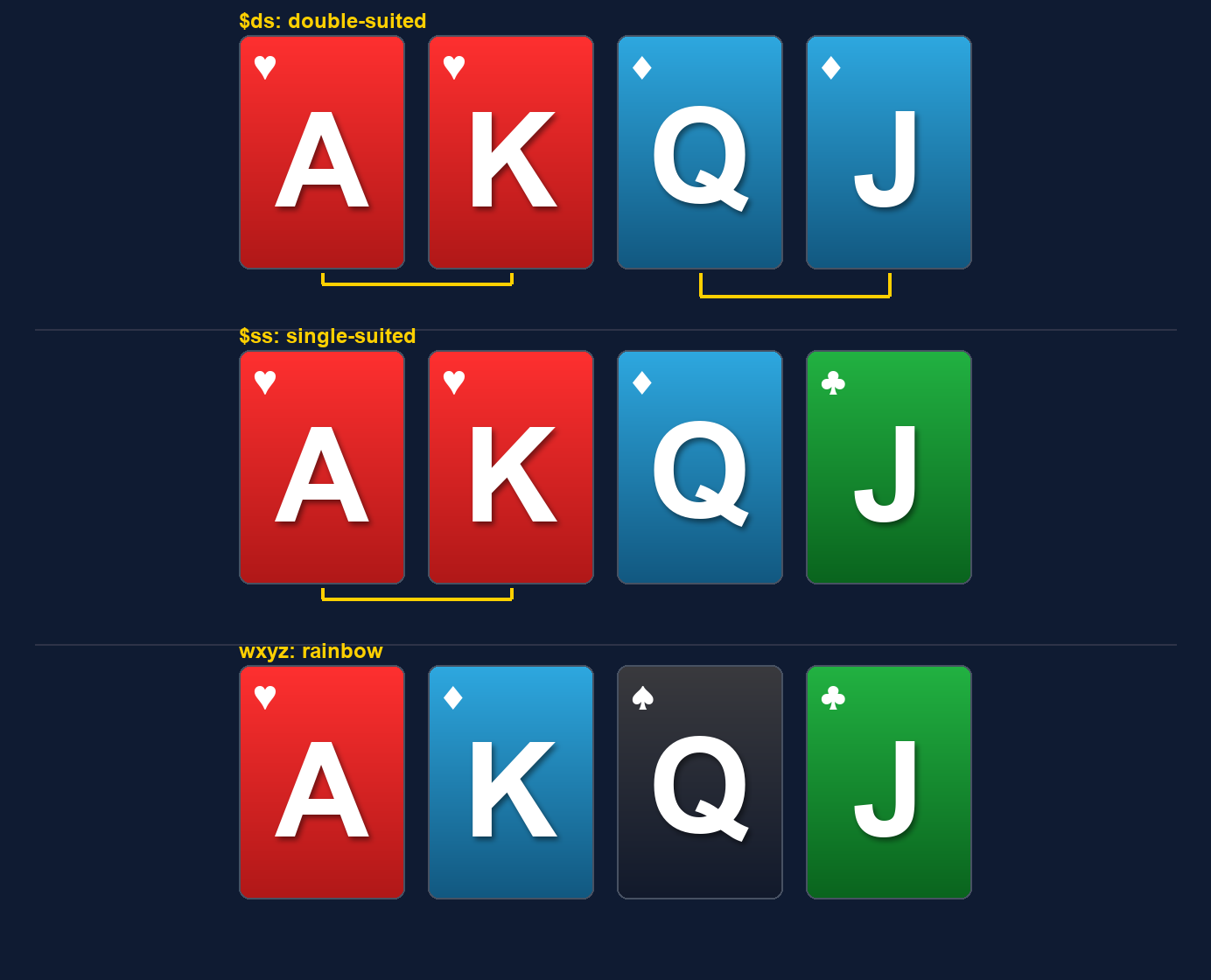
xxxx returns hands with four or more cards in one suit. In PLO4 that is monotone. In PLO5 and PLO6 it is any hand carrying a four-card suit group, a larger set. xxxxx and xxxxxx are the five- and six-card versions, and xxxxxx in PLO6 is the true monotone: 1,716 hand classes, roughly 0.03% of dealt hands, and they play badly because your own cards block the flush.
wxyz is rainbow: no two cards share a suit. It is a PLO4 pattern; in PLO5 and PLO6 it returns nothing. The least suited PLO6 structure is double-suited with no group larger than a pair, which you can search as $ds!xxx.
Aces and suits: AxAyxy, AxAzx!zz and Az!zz
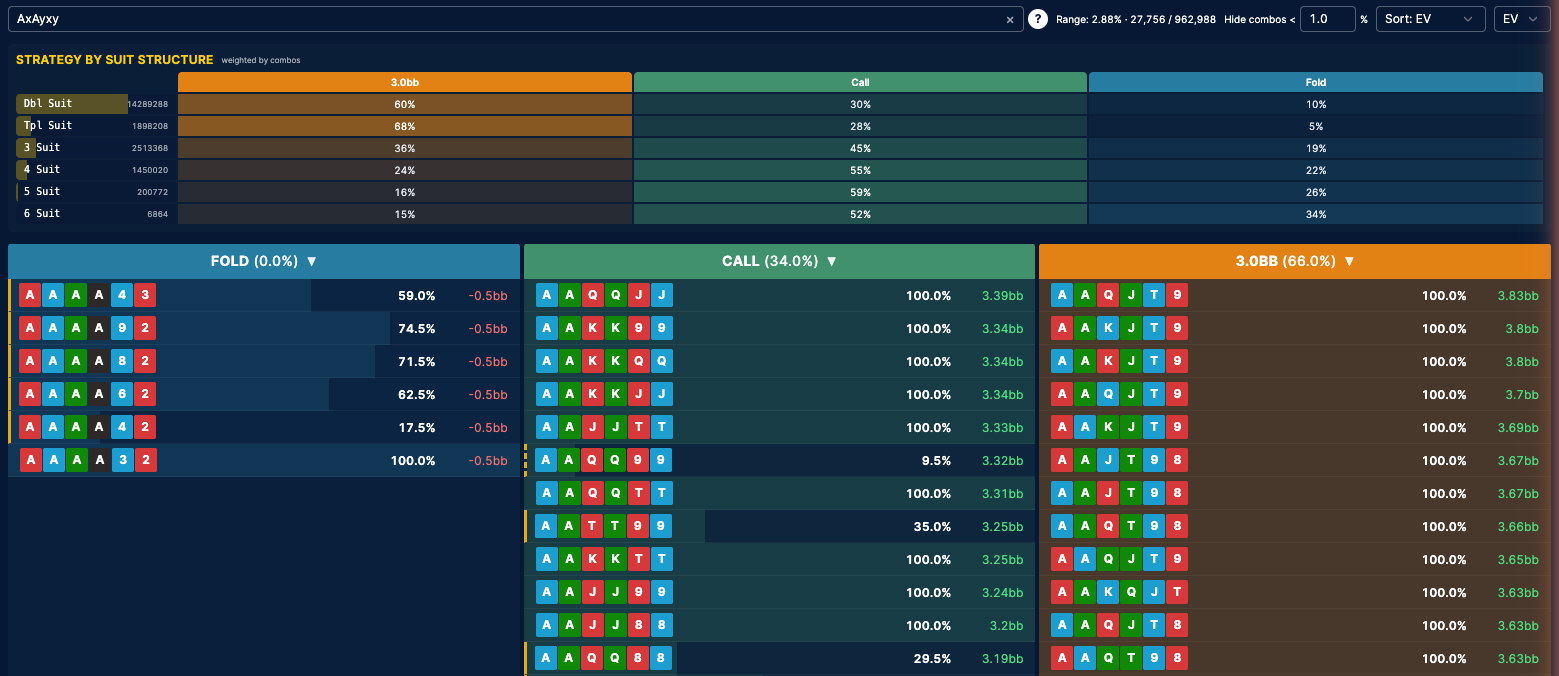
The placeholders attach to ranks. AxAyxy is double-suited aces: two aces in different suits, each suited to another card. AxAzx!zz is exactly one suited ace: one ace shares its suit with another card, the other ace is on a suit of its own. Az!zz is an ace on a suit no other card shares, useful when you want to see how much a lone ace's flush potential is worth (answer: nothing, which is the point).
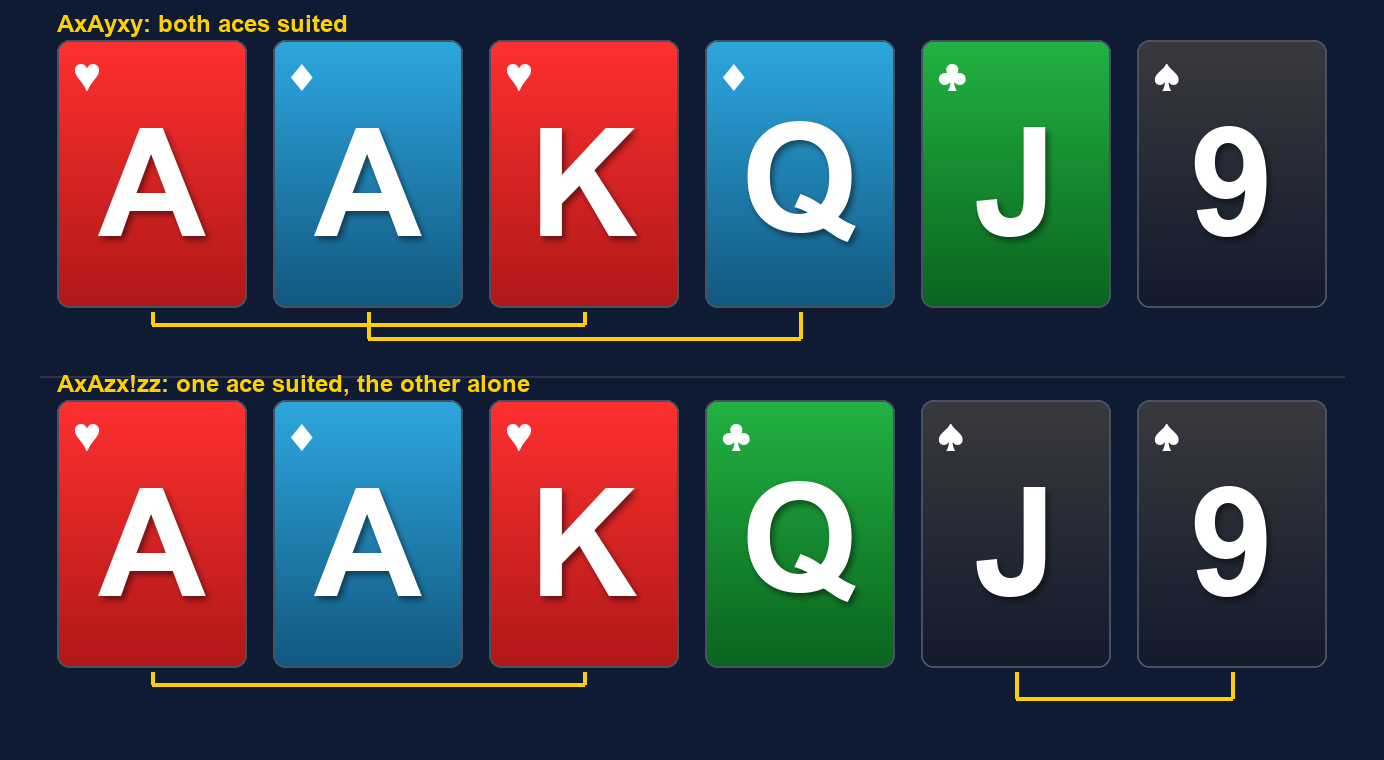
AxAyxz is looser than it looks: two aces with at least one of them suited to another card, so it also returns every double-suited-aces hand. Use AxAzx!zz when you mean exactly one suited ace.
The cards you leave unnamed are free: they may extend a named suit or form extra suited groups. AxAyxy therefore also returns hands with a third card in an ace's suit, and triple-suited hands. AA$ds is the narrower query: exactly two suited groups, with both aces inside them.
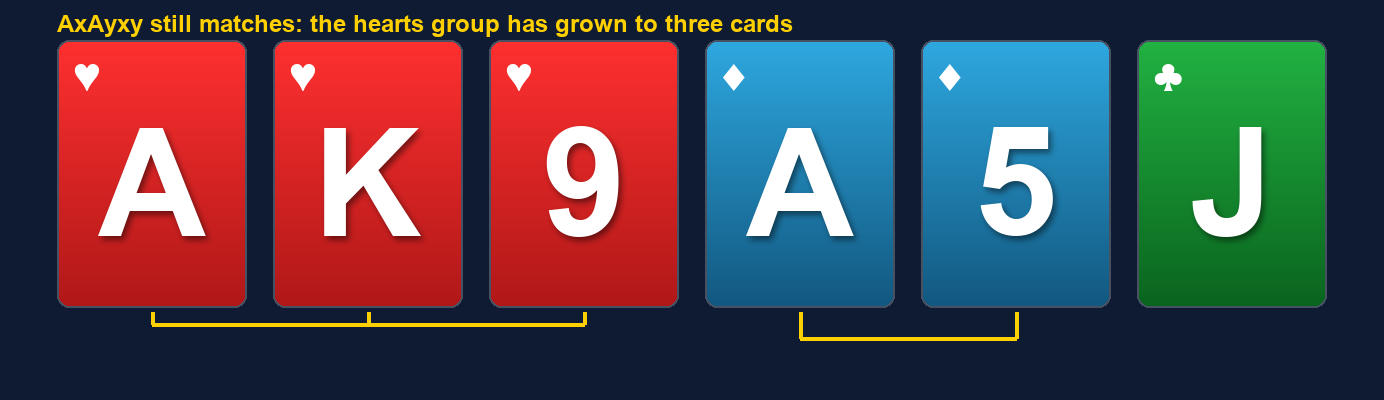
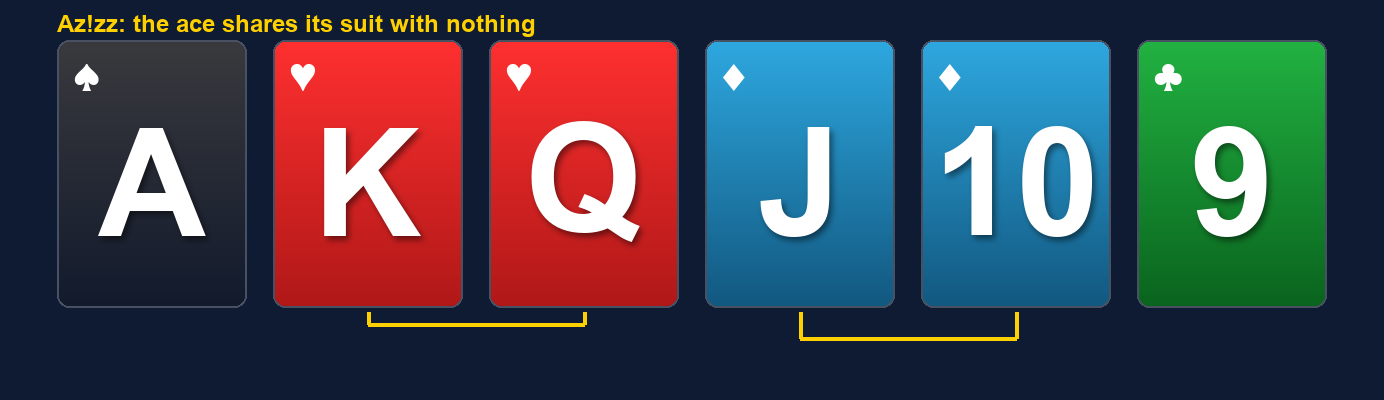
KJ*ss is a king and a jack plus a suited pair anywhere in the hand. The asterisk stands for "any other cards".
AzKz is an ace and a king sharing a suit, and AzKy an ace and a king in different suits. The binding letters work on any two ranks the same way.
Named suit structures: $ds, $ts, $ss, $np and $nt
The dollar prefix is a set of named filters for structural properties. $ds, $np and $nt are PPT's saved macros; $ts is RangeConverter's own, since PPT has no triple-suited macro.
| Modifier | Meaning |
|---|---|
$ds |
exactly double-suited: two suit groups, nothing else suited |
$ts |
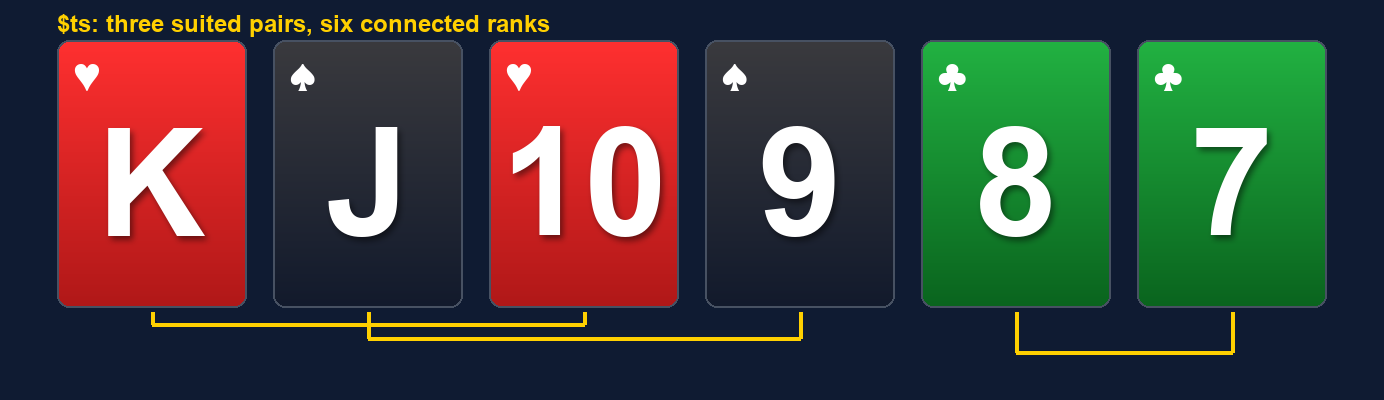
triple-suited: three suit pairs across six cards, PLO6 only |
$ss |
exactly one suited group and nothing else suited. It excludes double- and triple-suited hands. In PLO6 the one group always has three or more cards; in PLO4 and PLO5 it can be a pair |
$np |
no paired ranks: every rank in the hand is unique |
$nt |
no trips: no rank appears three or more times |
Combine them with ranks by writing them together: AA$ds, AA$ts, AA$nt. When $ds or $ts sits next to a single named rank, the search also requires the named cards to be inside the suit groups, so AA$ds means both aces are suited to something, not merely "has AA and happens to be double-suited". AA$nt is two or more aces minus any hand where any rank appears three times; for exactly two aces use AA!AAA.
Combine them with the same-suit patterns too: $dsxxx is double-suited with one of the groups being three or more cards, and AA$dsxxx adds the aces. There is no triple-suited version: a triple-suited six-card hand is three pairs, so no suit can hold three cards.
$np deserves a special mention. Pairs absorb cards that would otherwise be building straights and flushes, so unpaired hands play differently from paired hands of similar strength, and $np is how you separate them.
See it on your own spots. The examples on this page run in the HU 100bb PLO6 SB open, which is on PLO Reg along with every PLO4 and PLO5 preflop spot from HU to 6max, 20bb to 200bb. The search box is in the viewer on all of them. PLO Pro adds the multiway PLO6 set, 3max to 6max, the only place you can get those ranges. Playing PLO4? The whole syntax works there, and PLO4 has the one thing PLO6 does not: rainbow and off-suit structures you can filter for directly.
See PLO plansCombining filters: negation, colon, parentheses and chains
Negation with !
The exclamation mark means "not" and applies to whatever follows it. A!K is at least one ace and no king; aces with a king play differently from aces without one because of the blocker, so run both halves. AA!AAA is exactly two aces. AKT8!(Q,J) is A, K, T and 8 present with no queen and no jack; the bracketed list after the exclamation mark is a set of ranks to exclude together. !$ds, !$ts, !$ss, !$np, !$nt invert each modifier, so !$np is "has at least one pair" and !$nt is "has at least one trip".
The three broad exclusions all start from the full range:
| Pattern | Meaning |
|---|---|
*!xxx |
everything except hands with three or more of a suit |
*!RR |
hands with no pair at all |
*!RROO |
hands that are not two pair |
These are how you isolate the pure draw-only classes: rundowns and broadway hands without a pair sitting in the middle of them. A leading ! on its own is read as "everything except", so !RR and *!RR are the same query.
The colon, and precedence
The colon is AND. AA:$ds returns hands matching both sides. Writing two patterns next to each other usually does the same thing, but the colon is explicit, it works with every pattern type, and it is the only way to attach an action filter or a percentile band. *:xx or just :xx is every hand with a suited pair (a leading colon is read as "all hands and"). A!K:Q chains left to right: hands with an ace and no king, and then also a queen. *:xx!RR is suited hands with no pair.
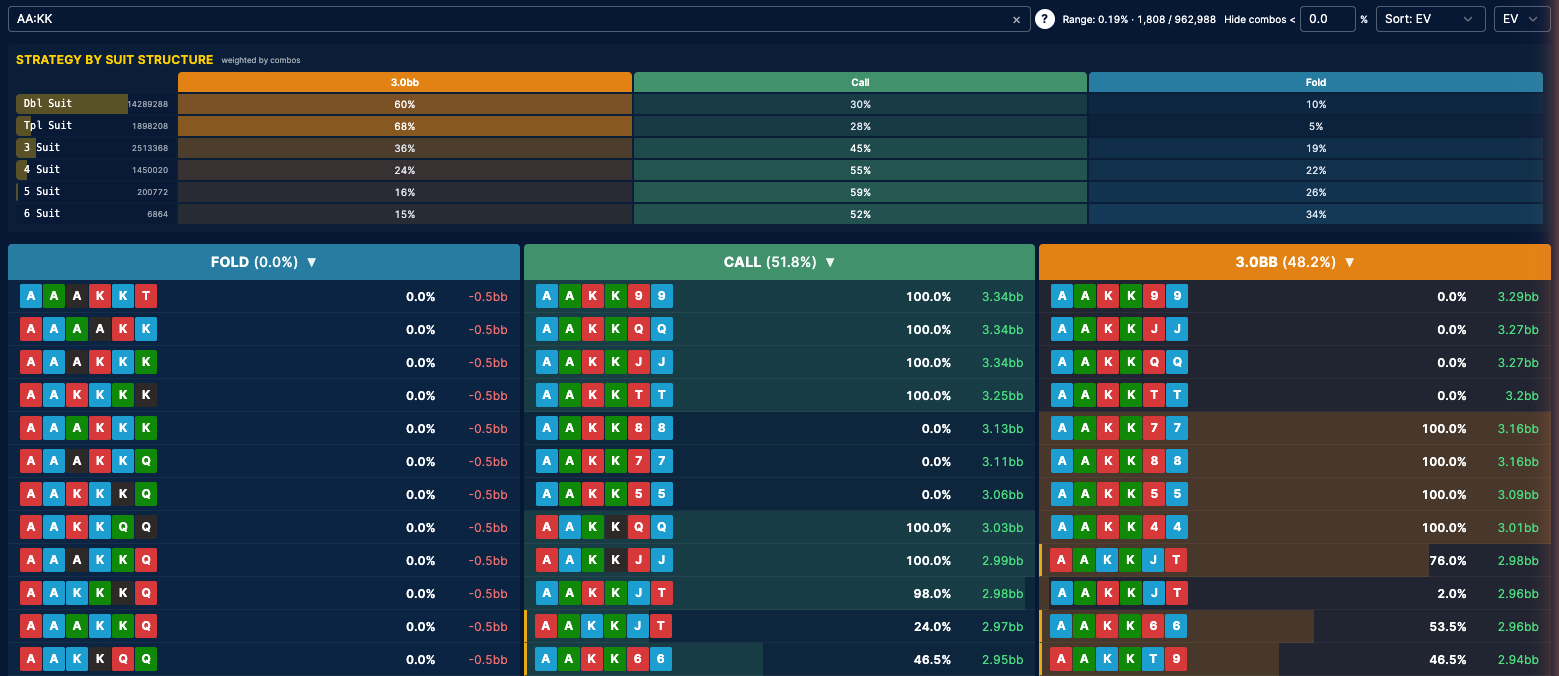
Precedence, lowest to highest: comma, then colon and exclamation mark, then parentheses. So AA,KK:$ds is "aces, or (kings and double-suited)", not "(aces or kings) and double-suited". When you want the second reading, use parentheses: (AA,KK):$ds.
Grouping with parentheses
Parentheses group a comma list so an operator applies to each arm. (AK,JT):xx is "AK suited or JT suited"; without the parentheses the colon would only bind to JT. (AK,JT)!RR is "AK without a pair, or JT without a pair". (AK,JT):($ds,$ts) cross-multiplies: AK double-suited, AK triple-suited, JT double-suited, JT triple-suited. AKT8!(Q,J) is the exclusion-list form from the negation section, the same mechanism.
Chaining three or more
Filters stack until you have described the exact hand class you want. AA$ds!K is a pair of aces, double-suited, no king. AA!$nt is two or more aces and at least one trip somewhere: set-of-aces hands, plus AA with trips of another rank. RR$ss is any pair in a single-suited hand. AARR$ds is aces plus a side pair, double-suited, which is the elite top-of-range shape in PLO6.
Percentile bands and action filters
Percentile bands: slicing a range by preflop equity
The percentile bands use a fixed preflop-equity ranking of every hand class: 16,432 in PLO4, 134,459 in PLO5 and 962,988 in PLO6, once the 270,725, 2,598,960 and 20,358,520 dealt hands are collapsed by suit structure. A band selects the classes in that slice of the ranking and shows the ones present in the displayed range. PLO6 equities sit unusually close together, which is why these bands earn their keep; the reasons are in why PLO6 equities run so close.
15% is the top 15% of hand classes. 30%-50% is the band from the 30th to the 50th percentile. Attach a band to any filter with the colon: AA:5% is the aces that sit in the top 5%, 25%:$ds is double-suited hands in the top 25%, 40%!RR is the top 40% with no pair (the premium draw-only hands), and ([T+][T+][T+], ss):15% is high-card or suited hands within the top 15%.
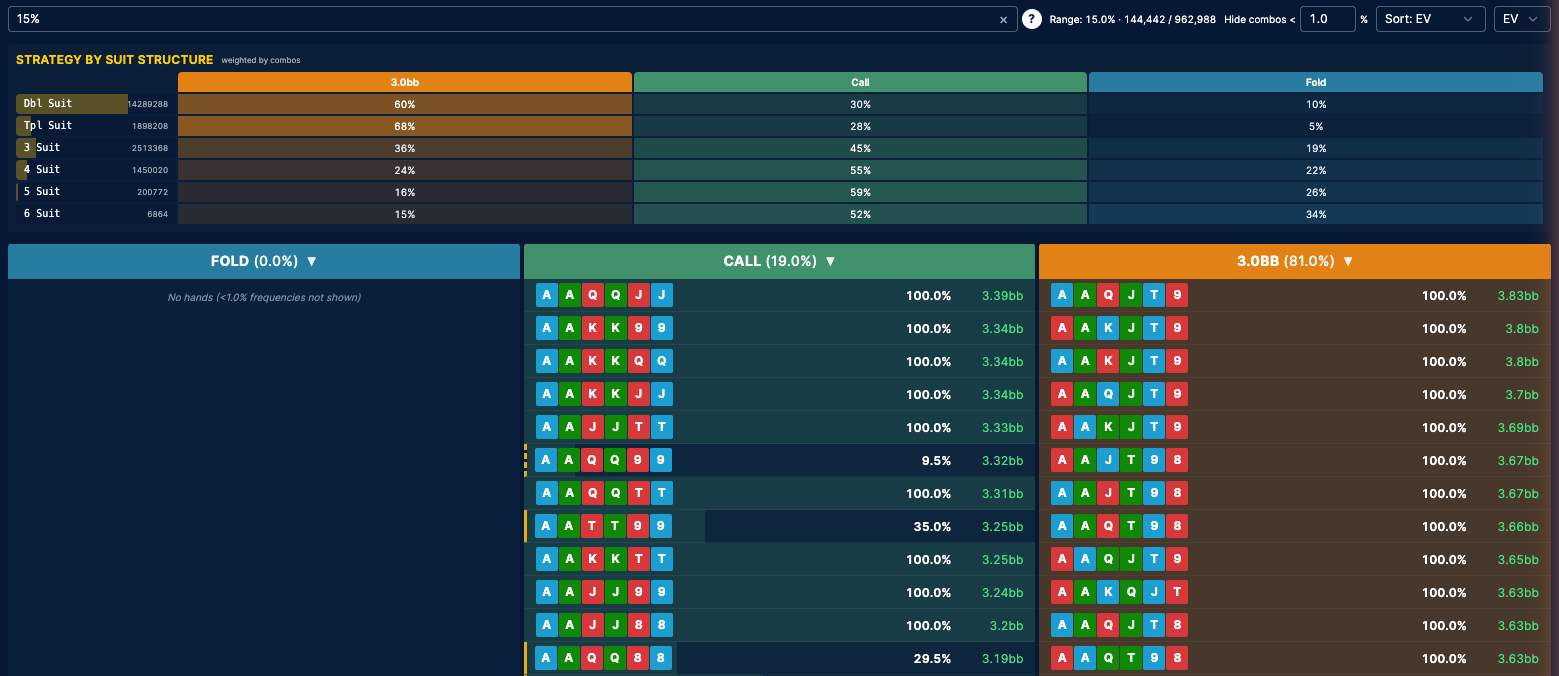
The ranking does not change from spot to spot: 15% in the SB opening range and 15% in a BB 3-bet range pick the same hand classes, restricted to whichever range is on screen. Run 15%, 30%-50% and 70%-100% in one spot and read the action mix across them. It is the fastest way to see how a range treats strong, middling and weak starting hands.
Action filters: bet sizes, Call, Fold and Allin
An action label is searchable when it matches the whole button text in the spot. In the HU 100bb PLO6 SB opening spot the labels are 3.0bb, Call and Fold.
3.0bb alone returns every hand that raises at least as often as the "Hide combos <" threshold (1% by default). Fold returns every hand that folds some of the time, Call every hand that calls or limps, and Allin works in spots that have it. Results come back as one column per action, each row a hand class with the frequency it takes that action and its EV, and a search narrows all three columns at once.
To combine an action with a filter, join them with a colon: TT-77:Fold, AA$ds:3.0bb, [T+][T+][T+]$ts:3.0bb, 3.0bb:80%-100%. The order does not matter: Fold:TT-77 reads the same as TT-77:Fold.
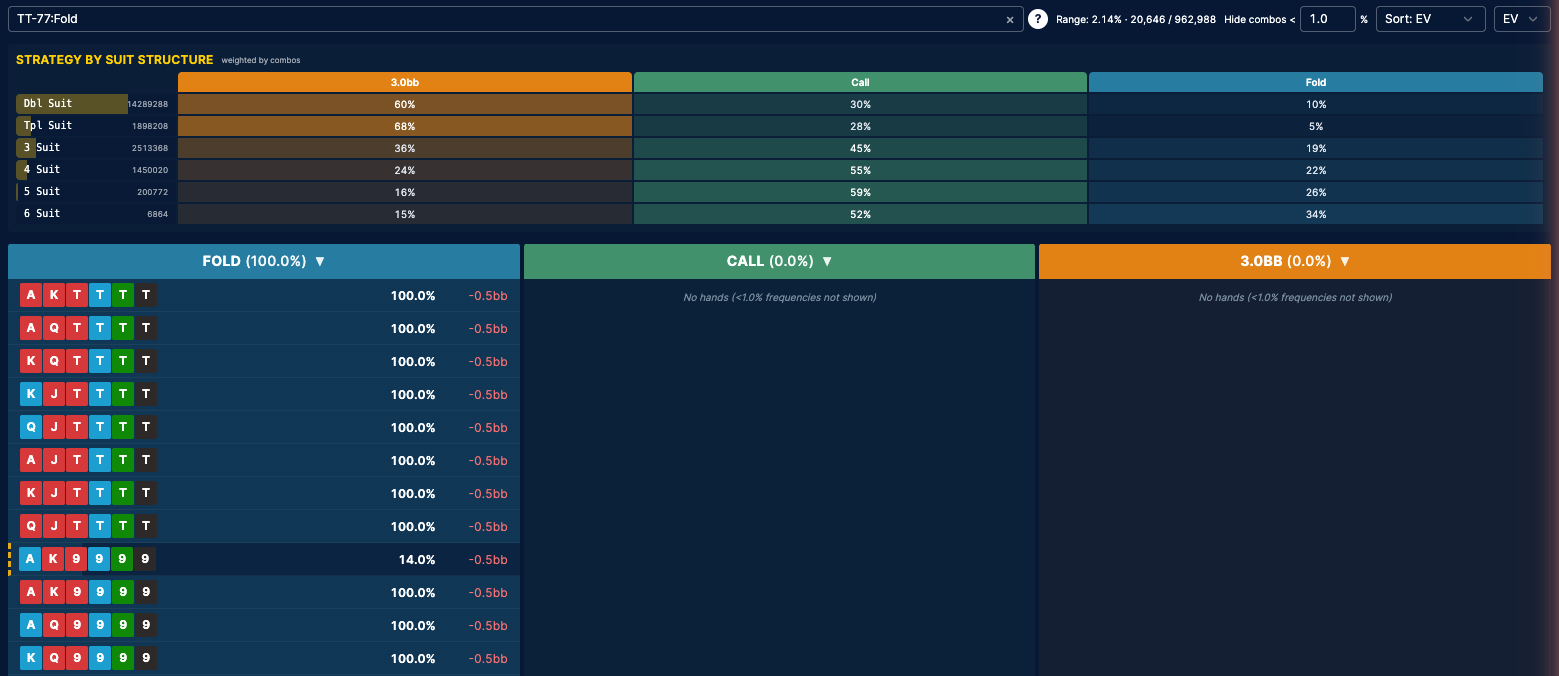
The action token also takes a hand group after a plus sign, matching the suit-structure table's own labels: 3.0bb+Dbl Suit is the raising hands that are double-suited. It is the same information as $ds:3.0bb, so use whichever you remember.
3.0bb:80%-100% is worth a moment. It is the weakest fifth of hand classes by preflop equity that still raises with some frequency: the edge of the strategy.
Six study questions you can only answer by searching
Searching finds the pattern; the trainer drills it afterwards (the GTO Poker Trainer guide shows how). Six questions that are hard to answer any other way; for the strategy behind the answers, read hand selection in 6-card Omaha.
How big is the double-suited aces gap in PLO6?
The single most asked "obvious but how big" question in PLO6. AA on its own hides it. Run AxAyxy (both aces suited), then AxAzx!zz (exactly one ace suited), then AA for the whole set, and read the raise frequency and the EV per combo across the three. There is no single pattern for "neither ace suited"; the gap between AA and the first two shows it. In most PLO6 spots the suit structure of your aces does more work than the ranks of your kickers.
What is a triple-suited rundown worth?
[T+][T+][T+]$ts is a small population by combo count and an outsized one by EV. Compare it against [T+][T+][T+]$ds and [T+][T+][T+]$ss to see what the third suit pair adds. Then do the same for middle rundowns with 9876:$ts and 9876:$ds.
Where do wraps stop being raises?
Because the dash pattern expands downward, compare the tiers without it: JT98, T987, 9876, 8765, 5432. Watch the raise frequency move as the anchor card drops, then add $ds to each and see how much suitedness props up the lower tiers.
What does a dangler cost?
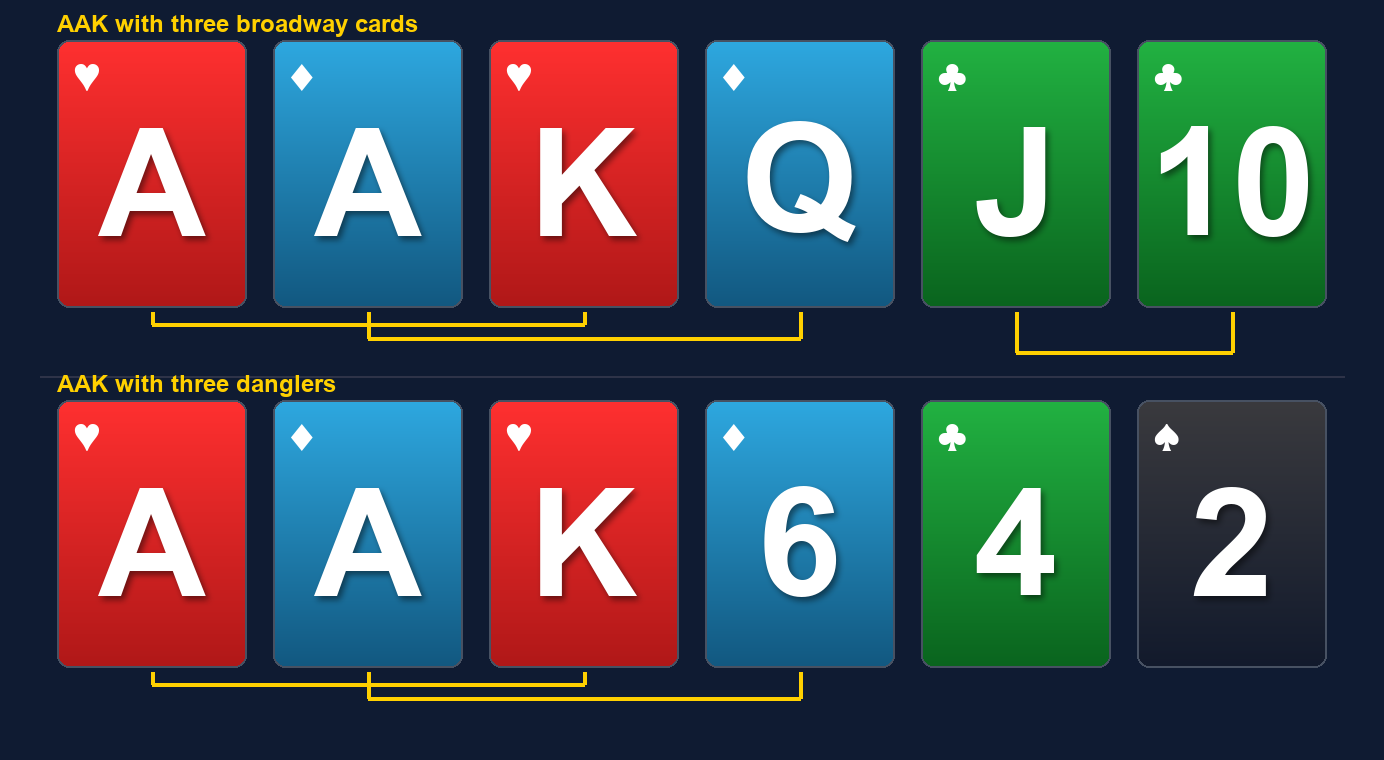
A dangler is a card that connects to nothing else in the hand. There is no $dangler filter, but you can bracket the effect. AAK[Q-T][Q-T][Q-T] is AAK with three more broadway cards. AAK[6-][6-][6-] is AAK with three low cards that play with nothing. The combo counts differ; what matters is how the action mix shifts between the two.
How much is double-suited worth in PLO4?
The one question PLO6 cannot ask, because every PLO6 hand is suited somewhere. In a PLO4 spot run $ds, then $ss, then wxyz, and read the action mix across the three suit structures. Then narrow each with a rank, such as AK$ds, AK$ss and AK:wxyz, to see the same gap inside one rank shape.
What did the solver want with the hand I held?
Type the six cards: AdAcKhJh9d3s in the BB-facing-open node. The row shows the frequencies and EV for that exact class. Then run AA for context and see whether your specific suit pattern sits above or below the average for aces in that spot.
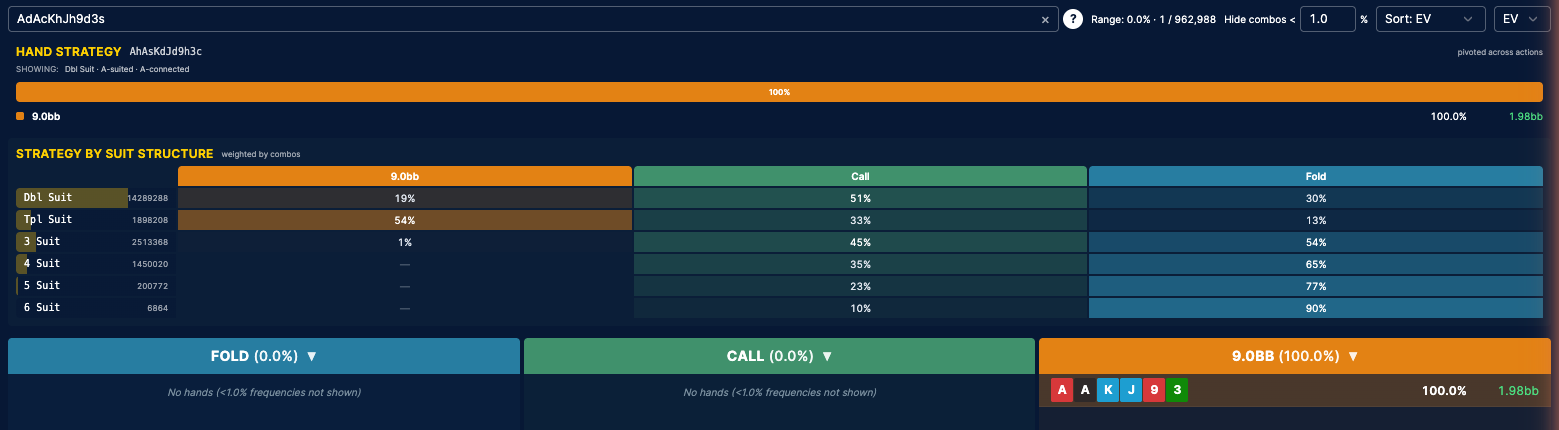
Run these questions yourself. Every query on this page works in the viewer's hand search box. PLO Reg covers PLO4 and PLO5 in full, HU to 6max at 20bb to 200bb, plus PLO6 heads-up at 50bb and 100bb. PLO Pro adds multiway PLO6, 3max to 6max. Both tiers include the trainer, so you can drill a spot straight after you study it.
Get PLO RegWhen a search returns nothing
When a query you expected to work returns nothing, or returns everything, it is almost always one of these.
- Comma where AND was meant.
AA, $dsis aces or double-suited.AA$dsis double-suited aces. - Forgetting that everything means "at least".
AAincludes AAA and AAAA.ssincludes triple-suited hands. Use$nt,!, or the exact$dsand$tsmodifiers to pin things down. - Zeros for the letter O.
RROOandJRONare letters.RR00returns nothing, because the search finds no rank letters in it. - Rundown dash surprise.
9876-includes 8765 and everything below. Drop the dash to study one tier. - Percentile without context.
15%is the top 15% of all hand classes by preflop equity, shown only for the hands in the range on screen; it is not the top 15% of that range. - Brackets for parentheses.
[A,K]is one slot holding an A or a K.(A,K)is a grouped OR of two arms. As standalone searches they return the same hands; they differ once you build on them:[A,K][A,K]asks for two cards from A and K, while(A,K):xxappliesxxto each arm.
PLO4, PLO5 and PLO6: what changes
Nearly everything here works identically across 4-card, 5-card and 6-card Omaha. The exceptions come down to card count and suit count. Action labels work the same way in all three: sizes, Call, Fold and Allin, on either side of the colon. New to six-card Omaha? What is PLO6? covers the game itself.
| Pattern | PLO4 | PLO5 | PLO6 |
|---|---|---|---|
$ts triple-suited |
not possible | not possible | works |
$ss single-suited |
one suited group of 2, 3 or 4 cards | one suited group of 2 to 5 cards | one suited group of 3 to 6 cards |
xxxx |
monotone | any 4-card suit group | any 4-card suit group |
xxxxx |
not possible | monotone | any 5-card suit group |
xxxxxx |
not possible | not possible | monotone |
wxyz rainbow |
works | returns nothing | returns nothing |
| Off Suit and 2 Suit structures | exist | 2 Suit only | neither exists |
{$L$L$L$L} |
any slot count up to four | up to five | up to six |
JRON |
jack plus 3 distinct | jack plus 4 distinct | jack plus 5 distinct |
| Explicit hand | four cards | five cards | six cards |
PLO hand search cheat sheet
The right-hand column is the number of PLO6 hand classes the pattern matches, out of 962,988, for patterns whose result does not depend on the spot.
Ranks, ranges and shapes
| Pattern | Meaning | PLO6 classes |
|---|---|---|
* or root |
every hand | 962,988 |
K |
at least one king | 380,076 |
AA |
two or more aces | 59,976 |
AA!AAA |
exactly two aces | 55,716 |
AKQJ |
every listed rank present | 10,200 |
Q+ / A-Q |
at least one card Q or higher | 778,458 |
TT-77 |
a pair in the listed range | 229,104 |
9876- |
that rundown and every same-length rundown below it | 43,576 |
[T+][T+][T+] |
three cards T or higher | 406,596 |
J[T-][T-][T-][T-][T-] |
jack-high | 71,262 |
K[2,J,T] |
king plus one of 2, J, T | 290,022 |
RR / RRR / RROO |
pair / trips / two pair | 642,096 / 55,224 / 134,160 |
AARR |
aces plus a side pair | 20,076 |
JRON |
jack, all other ranks distinct | 148,104 |
{$L$L$L$L$L$L} |
six unpaired low cards (A, 2-8) | 5,236 |
AdJdTc7h4s3h |
one exact hand class | 1 |
Suits and named structures
| Pattern | Meaning | PLO6 classes |
|---|---|---|
ss / xx |
at least one suited pair (every hand in PLO5 and PLO6) | 962,988 |
xxx (also hhh) |
three or more of one suit; the letter makes no difference | 600,457 |
hhxx / xxyy |
at least two suited groups (double- or triple-suited) | 749,346 |
xxxx |
four or more of one suit | 139,282 |
xxxxxx |
six of a suit (PLO6 monotone) | 1,716 |
wxyz |
rainbow (PLO4 only) | 0 |
AxAyxy |
double-suited aces | 27,757 |
AxAzx!zz |
exactly one ace suited | 28,459 |
Az!zz |
ace on a singleton suit | 70,510 |
KJ*ss |
K and J plus a suited pair anywhere | 134,248 |
$ds |
exactly double-suited | 667,186 |
$ts |
triple-suited (PLO6) | 82,160 |
$ss |
exactly one suited group | 213,642 |
$np / $nt |
no pairs / no trips | 320,892 / 907,764 |
$dsxxx |
double-suited with a 3+ group | 386,815 |
AA$ds |
double-suited aces, both aces inside the groups | 22,245 |
Combining
| Pattern | Meaning | PLO6 classes |
|---|---|---|
A!K |
ace, no king | 245,828 |
AKT8!(Q,J) |
AKT8, no Q, no J | 6,675 |
!$ds and the rest |
invert any modifier | |
*!xxx / *!RR / *!RROO |
exclude 3-flush / any pair / two pair | 362,531 / 320,892 / 828,828 |
AA:$ds |
both filters (AND) | 41,748 |
:xx |
all hands AND xx | 962,988 |
(AK,JT):xx |
distribute over the arms | 258,296 |
(AK,JT):($ds,$ts) |
cross product | 200,738 |
AA$ds!K |
three filters chained | 15,763 |
Percentile and action
| Pattern | Meaning |
|---|---|
15% |
top 15% of all hand classes by preflop equity, within the displayed range |
30%-50% |
a band |
AA:5% |
filter within a band |
3.0bb / Call / Fold / Allin |
hands taking that action |
AA$ds:3.0bb |
filter and action together, either order |
3.0bb+Dbl Suit |
action plus suit-structure group |
FAQ
What is PLO hand search?
Hand search is the filter box in the RangeConverter PLO range viewer. You type a pattern and it returns every hand class in the displayed range that matches. The three result columns then recompute for that subset, and their headers show the action mix for exactly the hands you asked about.
Does AA mean exactly two aces in PLO?
No. Every pattern means "at least" unless it says otherwise, so AA returns two or more aces and includes AAA and AAAA. For exactly two aces write AA!AAA: at least two, minus at least three.
How do I search for double-suited aces in PLO6?
Use AxAyxy: two aces in different suits, each suited to one other card. AA$ds is narrower: exactly two suit groups, with both aces inside them. AxAzx!zz returns exactly one suited ace.
Can I search for a specific suit, such as hearts?
No. The viewer stores hand classes without specific suits, so hhh, ddd, sss and ccc are all read like xxx: three or more cards of any one suit. Suit letters only say which cards share a suit, never which suit that is.
What does $ds mean in a PLO search?
$ds is exactly double-suited: two suit groups and nothing else suited. $ts is triple-suited, PLO6 only. $ss is exactly one suited group. $np is no paired ranks and $nt is no trips. An exclamation mark in front inverts any of them.
What does the trailing dash in 9876- do?
The dash expands the rundown downward. 9876- matches 9876, 8765, 7654, 6543 and 5432, whatever the suits do. Length is preserved. Drop the dash to study one tier: 9876 alone pulls in no lower tier.
How is this different from ProPokerTools?
The notation is the same PPT range-of-hands syntax, so what you learned there carries over; one difference is that RangeConverter's $ss means any single suited group, not only a suited pair. What differs most is the answer. A hand-class counter tells you how often a class wins. The viewer tells you what the solver does with it in a specific spot: raise, call and fold frequencies and EV per combo, recomputed for whatever your search returned. That needs a solved range behind the box.