The PLO charts won’t save you: hand selection in 6-card Omaha
This is the trap that catches PLO regs when they cross over. The ranking of hands changes at six cards, and the reasons are structural rather than stylistic. A Q-Q-J-T double-suited PLO hand that you’d open without thinking from the cutoff is a hand of a different value when it has two more cards stapled to it. Sometimes those two extra cards make it stronger. Quite often they don’t.
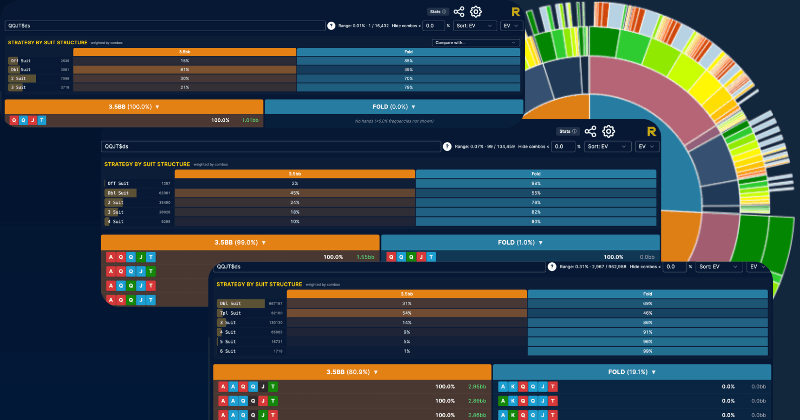 A A Q-Q-J-T double-suited hand in PLO vs PLO5 vs PLO6
The framework below is what holds up once you stop using PLO charts. If PLO6 itself is new to you, our guide to six-card Pot-Limit Omaha covers the rules and how the game differs from PLO before you dig into hand selection specifics.
Start with the maths, not the PLO heuristics
In PLO, your hand contains six two-card combinations. Each combination interacts with the board independently, but only six of them.
In six-card Omaha, your hand contains fifteen two-card combinations. That is the number that explains why the rankings shift. The full equity story behind that shift sits in our PLO6 equity compression guide; this piece focuses on what it means for hand selection.
Going from six pieces to fifteen does two things at once:
• It increases the number of ways your hand can connect to a flop. • It increases the chance that some of those connections are working in different directions, undermining each other.
The first effect is what makes PLO6 more action-heavy than PLO. The second effect is what makes hand selection harder. Six pieces all pulling toward the nut flush draw and the wrap is a strong six-card hand. Fifteen pieces where five of them want the flush, four want the straight, three are working on a backdoor, and the rest are dead weight is a mess.
The framework below is built around this idea. Not how many combinations your hand has (it has fifteen, by definition) but how many of them are productive.
PLO6 coordination beats raw card rank
This is the principle the rest of the framework hangs off. Hands where all six cards work together are worth meaningfully more than hands with two or three premium cards plus dead weight.
What “coordination” means in practice:
Double-suited matters more than in PLO. Two suits in your hole cards mean two flush paths. In PLO, that’s already a meaningful upgrade. At six cards with fifteen combinations to work with, it’s a structural advantage that can carry an otherwise medium hand into the playable range.
Triple-suited hands exist and they are real. The most coordinated six-card hands have three cards of one suit and three of another, or 3-2-1 distributions. These are different in kind from anything you see in PLO. When the flush hits in your colours, you have multiple ways to make the nuts.
Connected six-card structures matter. A hand like 9-8-7-6 in PLO is a connected hand. Add 5-4 to that hand and you have six rundown cards, fifteen combinations, and most of them looking at straights. That is a different beast to A-A-9-8-7-6, where two of the cards are pulling in a different direction to the others.
There’s a counterintuitive bit here. Stacking too many fully connected ranks in a six-card hand can self-block your own straight outs. A T-9-8-7-6-5 holds plenty of two-card rundowns but several of those rundowns share outs, so the marginal value of the fifth and sixth connected ranks is lower than the raw combinations count suggests. None of this makes a hand like T-9-8-7-6-5 weak. It’s still strong on boards that land in the connected range and it makes plenty of straights when the cards cooperate. The point is just that the lift from those last two cards isn’t as big as you’d expect, and the strongest connected six-card structures usually carry an ace as part of the package, which adds nut-flush blocker value and broadway straight potential on top of the rundown’s own straight-making.
The shift you have to make is from “what’s the rank of my best two cards” toward “how many of my fifteen combinations are productive on the boards I’ll see”.
Nut potential as the dominant filter
In PLO, you already know the nut-or-bust principle. Drawing to the nuts is more profitable than drawing to a second-best hand. The structure of the variant punishes chasing king-high flushes when an ace can show up.
In six-card Omaha, that effect is sharper because more players connect with more boards. Multiway pots get there more often. Non-nut made hands get cracked more often. The same king-high or queen-high flush draw that was a marginal but profitable holding in PLO is regularly a money-burner in six-card multiway pots, where someone in the field usually has the ace.
Practical implications:
• Hands that draw to second-best made hands lose value. This is most acute for non-nut flush draws and middle straights. • Hands that draw to the nuts gain value. Ace-suited combinations that include nut flush potential keep their value better than hands of similar nominal rank without that ace. • Trips in your hole cards are a deduction, not an asset. Three of a kind in your hand removes outs to the case card. If you hold three queens, only one queen is left in the deck and you can never make four queens with a fourth on the board. Pure mechanics.
PLO hands that quietly stop being premium at six cards
A few categories that PLO regs tend to overrate when they cross to PLO6:
A-A-X-X-X-X with mediocre side cards. In PLO, naked aces with two weak side cards are still profitable from many positions because aces have a real preflop equity edge. At six cards, you have four side cards rather than two, so the dead weight is doubled, and the equity edge is smaller on top of that. Aces with four random low or disconnected ranks are no longer the slam-dunk they look like in PLO. They’re still strong. They’re not strong enough to play the way you’d play AAxx in four-card Omaha.
Big pairs without coordination. K-K-J-T plus two random low or disconnected cards looks fine until you realise that those last two cards are doing nothing for you on most boards. The same hand without the trailing two cards (an actual four-card PLO hand) is strictly worse on its own, but the strategic gap between it and a fully coordinated six-card hand is wider in PLO6 than the equivalent gap is in PLO.
Connected middling hands missing suits. A rundown of T-9-8-7-6-5 with no flush capability is a one-dimensional hand. The same shape double-suited is something you can get involved with in spots a rainbow rundown won’t survive.
Mid-rank flush draws that aren’t to the nuts. Q-J-T-9-8-7 where the queen shares a suit with one other card can flop a queen-high flush draw, and in PLO that’s often enough. In six-card multiway pots, the queen-high flush draw is exactly the kind of holding that gets there second.
The whole PLO6 hand selection framework, in one paragraph
A useful six-card Omaha starting hand is one where most of your fifteen two-card combinations are doing productive work, your suit structure gives you nut flush potential, your card ranks don’t contain trips or low pairs, and the hand can build toward strong made hands or strong draws on the flops you are likely to see. Premium pairs are still good, but they are good because they are well-connected and well-suited, not because they are pairs.
That’s the core of PLO6 hand selection.
How to study six-card Omaha before you sit down
If you are coming from PLO and you want to ramp into six-card Omaha without burning through buy-ins on misvalued hands, three things help.
Pull a few hands you’d open without thinking in PLO and step them through RangeConverter’s PLO6 range viewer. The frequencies will recalibrate your instincts faster than reading about the recalibration. Some hands you’d auto-open in PLO move to mixed frequencies or fold in 6-card. Some hands you’d dismiss in PLO turn out to be playable. Either way, the gap between your gut and the solver is the lesson.
Study preflop ranges before anything else. Preflop is where PLO6 errors begin, because that’s where the equity differences from PLO bite first, and a wrong preflop range carries through into every postflop decision. The first PLO6 ranges are live in RangeConverter’s range viewer now, with the library growing as more sims are solved.
Drill spots in RangeConverter’s GTO Trainer rather than just reading them. The trainer pushes the same patterns at you across hundreds of hands until the right answer becomes the obvious one. Reading is slower and the lessons don’t stick as well.
When you do play, expect that the variance will feel worse than PLO5. The drawback of more combinations connecting to more boards is that you’ll be put in genuinely close decisions more often. That’s the variant. Bankroll for it.
PLO6 hand selection FAQ
What makes a strong PLO6 starting hand?
A hand where most of your fifteen two-card combinations are doing productive work, your suit structure includes nut flush potential, and your card ranks don’t contain trips or low pairs. Premium pairs are still good, but they’re good because they’re well-connected and well-suited, not because they’re pairs.
Can I use my PLO charts in PLO6?
No. The hand-strength curve flattens at six cards, and the relative value of hands changes with it. Coordinated medium-rank hands gain value, naked premium pairs lose some of their dominance, and non-nut flushes drop in value in multiway pots. PLO charts will systematically misvalue hands in 6-card Omaha.
Which PLO6 hands should I avoid?
Hands containing trips (three of a kind in your hole cards) reduce your outs to the case card and rarely make profitable openers. Hands with low pairs are weaker than equivalent unpaired hands because pairs in hand have only 2 outs to set, not 3. Rainbow rundowns without flush capability play one-dimensionally. Big pair hands where two or more of the cards are dead weight (e.g. K-K-J-T-X-X) look strong but those trailing cards do little work on most boards.