What is PLO6? A guide to 6-card Pot-Limit Omaha
PLO6 is Pot-Limit Omaha with six hole cards instead of four. Same hand-making rule, same betting structure, same hand rankings. The only thing that changes is the number of cards in your starting hand, and that one change runs through almost everything about how the game plays.
If you already play PLO and you’re wondering whether your charts and instincts carry over: not really. Here’s why.
The Omaha rule that hasn’t changed in PLO6
In every form of Omaha, you have to use exactly two of your hole cards and exactly three from the board. Not one. Not four. Two and three. That rule is what makes Omaha Omaha, and it doesn’t change in PLO6. You still need a board you can connect with using two specific cards from your hand.
Hand rankings are also identical to standard poker. Royal flush, straight flush, four of a kind, full house, flush, straight, three of a kind, two pair, one pair, high card. Same hierarchy as in any other poker variant (apart from short deck and lowball variants like Razz or 2-7).
The betting is pot-limit. The maximum bet or raise on any street is the size of the pot, including the call you would need to make. If that maths is rusty, the formula is three times the previous bet plus everything else already in the pot.
What changes at six cards: the maths of starting hands
This is the bit that catches people. In four-card PLO, you have your hand and you have to pick two cards from it. With four cards in your hand, you can pick two in six different ways. Six two-card combinations, every hand.
PLO5 gives you five cards. Ten combinations.
PLO6 gives you six cards. Fifteen combinations.
Going from six pieces to fifteen sounds incremental until you actually think about what it does to a flop. Most flops now connect to most starting hands in some way. Boards that used to miss your range find a piece of it. Two-pair, sets, wraps, flush draws, the lot. The connection rate goes up because there are simply more ways to connect.
That’s the headline change. The rest of the strategic differences follow from it.
Where PLO6 sits today
Six-card Omaha is a relatively recent addition to the online poker map. The major sites added it in waves over the last few years and a handful of smaller and crypto-friendly rooms now spread it as a regular cash variant. It’s not yet on every site that runs PLO5, the player pool is smaller, and finding a game can take some looking, especially at higher stakes.
The strategic depth is what catches the eye more than the player numbers. Six-card Omaha plays differently enough from PLO and PLO5 that the games attract a particular kind of player: regs from PLO who want a bigger edge surface, action players who like the swings, and a smaller group who have decided this is the variant they want to specialise in. The result is games that are often softer than equivalent-stake PLO at the same room, but harder to find.
Why preflop equities run so close at six cards
This is the strategic insight that defines the game. Worth getting your head around before you put money on the table.
In NLHE, pocket aces are dominant. In four-card PLO, that dominance shrinks. At six cards, it shrinks again, and the gap between premium hands and the rest of the field gets meaningfully smaller. The mechanism is what we just said about combinations. With fifteen two-card pieces in every hand, most preflop ranges hit most flops in some way. There is less room for one hand to dominate another, and there are more ways for the trailing hand to find a draw, a redraw, or a backdoor that closes the gap.
A few things change as a result:
- • Your 3-bet ranges have to change, particularly out of position. Out-of-position equity realisation is harder, and in PLO6 you can’t afford to add the OOP penalty on top of an already-thin equity edge.
- • Position becomes more valuable. Postflop trees deepen, mistakes cost more, and the proportional value of being last to act goes up.
- • Hand selection is no longer about raw rank. It’s about how the six cards work together.
What PLO players shouldn’t bring across to PLO6
If you already play four-card Omaha, here’s the trap. Your PLO charts don’t work in PLO6. The relative value of hands changes once the curve flattens, and a few categories take the biggest hit:
Premium pairs become less premium. Aces are still the best starting hand class, but the gap between aces and the next tier is smaller. Slow-playing them more often, or mixing in a passive line, is a real consideration in a way it wasn’t in PLO.
Non-nut flushes lose value. The same king-high or queen-high flush that was a winner in heads-up PLO is regularly second-best in six-card multiway pots, where ranges connect harder and someone often has the ace.
Two pair holds up less well. Already a frequently overplayed hand in PLO, two pair runs into more outdraws when fifteen two-card combos are looking for them.
Six-card hand selection is a topic in its own right. Our PLO6 hand selection framework goes deeper.
Studying six-card Omaha with RangeConverter’s PLO6 range viewer
If you want to study six-card Omaha properly, the bottleneck is preflop. Get preflop wrong and the rest of the tree goes off-track before you reach the flop. Get preflop right and the postflop decisions are at least sitting on solid ground.
The first PLO6 preflop solutions are now live in RangeConverter’s PLO6 range viewer. You can step through the ranges, see how the strategy shifts by position, and drill the spots in RangeConverter’s GTO Trainer until the patterns are second nature. More PLO6 sims are being solved, so the library keeps expanding.
Preflop is where most of the PLO6 EV is decided, and it’s where the strategy diverges most clearly from PLO and PLO5. Studying it properly pays off more than any other prep work a PLO player can do before sitting down at a six-card table.
Six-card Omaha FAQ
Is PLO6 the same as 6-card Omaha?
Yes. The names are interchangeable. “Pot-Limit Omaha 6-card”, “PLO6” and “6-card Omaha” all refer to the same game.
Do I have to use exactly two hole cards in PLO6?
Yes. Same as PLO and PLO5. Two from your hand, three from the board. Always.
Is PLO6 just a more random version of PLO?
It plays with more variance because equities run closer and more flops connect to more ranges. That’s not the same as randomness. Skill edges still exist, they just show up in different parts of the game: hand selection, OOP play, and equity realisation rather than raw preflop dominance.
Should I use my PLO charts in PLO6?
No. The hand-strength curve is different and the strategic implications follow. Coordinated, double-suited and triple-suited hands gain value relative to high pairs, and the overall shape of a profitable opening range isn’t the same.
How big a bankroll do I need for PLO6 versus PLO?
More. Variance runs higher than PLO and meaningfully higher than PLO5, because the equity edges are smaller and more pots get to showdown with both players holding real equity. Treat your PLO bankroll guidelines as a floor, not a target.
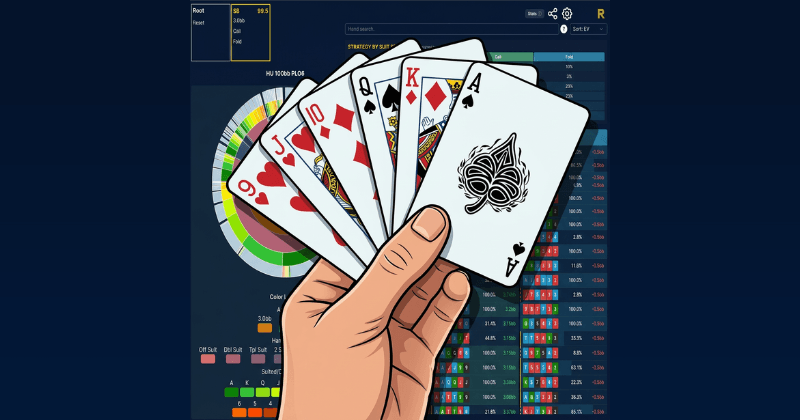 PLO6 now available at rangeconverter.com