Why PLO6 equities run so close, and what it means for your strategy
The instinct isn’t wrong, just calibrated to a different game. All of those surprises trace back to one thing: preflop equities run closer in PLO6 than they do in PLO or PLO5. That one fact drives almost every adjustment you have to make coming from four-card or five-card Omaha.
If PLO6 itself is new to you, our guide to six-card Pot-Limit Omaha covers the rules and the maths first. This piece assumes you’re past the basics and want the strategic implications of what those compressed equities actually mean at the table.
The simplest way to see equity compression in six-card Omaha
In four-card PLO, your hand contains six two-card combinations. Each combination is a separate two-card piece that could combine with the board to make a five-card hand.
In six-card Omaha, your hand contains fifteen two-card combinations. Same single hand, fifteen separate two-card weapons looking at the same flop.
When two players square off preflop, you are comparing fifteen combinations against fifteen combinations across thousands of possible boards. The arithmetic of dominance just doesn’t work the same way. There are too many ways for the trailing hand to find a pair, a draw, a redraw, or a backdoor that closes the gap.
That’s the structural reason equities compress in 6-card Omaha. It isn’t a stylistic claim. It’s a counting argument.
What compressed equities look like at the tables
The aces case is the easiest one to feel. In NLHE, pocket aces dominate. In PLO, naked aces are still the best starting hand class but the dominance is meaningfully thinner. At six cards, that dominance thins again. The gap between aces and the next tier of strong hands is smaller than it is in either PLO or PLO5, and the gap between aces and a coordinated medium-rank hand is smaller still.
Step through the six-card Omaha ranges in RangeConverter’s PLO6 range viewer and the pattern shows up right across the curve. The very strongest hands keep some preflop edge, but the edge is smaller than the equivalent hand carries in PLO, and the strategy reflects that. Hands you’d play straightforward in PLO start showing up as mixes or slow-plays. Out of position, the ranges tighten earlier than your PLO instincts expect.
One thing to notice: PLO6 solver ranges include a fair amount of mixed-frequency play, particularly in 3-bet decisions. Hands sit at partial frequencies (say 60% open / 40% fold) rather than at clean 100% open or 100% fold. The reason follows from compressed equity. When a hand sits close to break-even, the solver’s optimal answer is a mix rather than a pure decision. Reading PLO6 ranges as binary will get you the wrong answer.
The shape of the curve matters more than any single number. The six-card curve is flatter, with the top end slightly lower and the middle slightly higher than the equivalent PLO curve. That flatness is what changes the strategy.
How this changes the way you play PLO6
Three things change once preflop equity compresses.
1. Out-of-position 3-betting has to tighten
Out of position you under-realise equity already. There’s a name for this: the OOP equity realisation penalty. You have to act first on every postflop street, you can’t take free cards in position, and you regularly fold hands that have decent showdown value but can’t continue against a bet. In a game where your equity edge is rarely large to start with, you can’t afford to add the OOP penalty on top of an already thin edge.
A hand that 3-bets profitably from the small blind in PLO can easily turn into a 3-bet that bleeds chips at six cards, because the equity edge it relied on is thinner and the OOP penalty stays the same size. If you are bringing PLO 3-bet ranges across to PLO6 unchanged, you are probably opening up too much from the blinds and giving back EV that your in-position 3-bets are working hard to earn.
The correction is tighter OOP 3-bet ranges, more flat-calling with hands that have decent playability, and reserving the 3-bet for hands that hold their value across the flops you’ll see.
2. Position is worth more at six cards, not less
Standard position reasoning still applies: in position you over-realise equity by taking free cards, bluffing, and controlling pot size; out of position you under-realise.
The size of those errors is bounded by how often you have an equity edge to start with. In PLO, the equity edges are bigger, so the OOP and IP gap is partially insured by the size of your edge. In six-card Omaha, the equity edges are smaller, so the proportional cost of being out of position is larger. Position is doing more of the heavy lifting.
Late position widens, early position tightens, and the gap between the two is bigger than it is in PLO. This is one of the few places where the right adjustment is the simple one: respect position more.
3. Hand selection has to shift
If your equity edges are smaller, the only way to keep your edge real is to widen the gap somewhere else. That gap has to come from hand quality. Not raw rank, but coordination, suit overlap, and the ability to flop nut draws across multiple paths.
A double-suited connected six-card hand carries fifteen two-card combinations that interact richly with most boards. A six-card hand with two random low cards stuck on the back of an otherwise strong PLO hand carries the same fifteen combinations, but most of them are doing nothing productive. The gap between those two hands is bigger in PLO6 than the equivalent gap in PLO, because the structure of the variant rewards coordination more.
Coordination, suit overlap and nut potential are covered in detail in our PLO6 hand selection framework.
What to take into your PLO6 study sessions
If you study PLO6 the way you studied PLO, you will end up overestimating premium pairs, opening too wide out of position, and 3-betting in spots where the equity edge is too thin to survive bad realisation.
A more useful study workflow:
• Start with how the strategy treats premium hands. Step through a few AA hands in RangeConverter’s PLO6 ranges and the equivalent PLO ranges, and let the difference recalibrate your instincts. Solver mixes do the work that paragraphs of theory can’t. • Study OOP scenarios first, not last. The biggest preflop EV mistakes in PLO6 sit in the small and big blind 3-bet decisions. If your charts there are wrong, the rest of the tree gets distorted. • Pay attention to range shape, not just hand strength. PLO6 strategy is more about how your range covers the board than about which specific hand you happen to have. • Drill the spots, don’t just read them. RangeConverter’s GTO Trainer pushes the same patterns at you over and over until they stop being theoretical.
Expect the variance to feel worse than PLO5. The drawback of more combinations connecting to more boards is that you’ll be put in genuinely close decisions more often. That’s the variant. Bankroll for it.
The skill ceiling is high. A study edge in PLO6 compounds faster than the same edge in PLO, because the surface area of mistakes is bigger and most of the field is still working out where the new equilibria sit.
The first PLO6 preflop ranges are now live in RangeConverter’s PLO6 range viewer, with the library expanding as more sims land. Preflop is where the biggest PLO6 errors live, and preflop is where solver ranges give you the cleanest correction.
PLO6 equity FAQ
Why are PLO6 equities closer than PLO equities?
More hole cards means more two-card combinations interacting with the board. With fifteen combinations per hand instead of six, most preflop ranges hit most flops in some way. There is less room for one hand to dominate another, so the gap between premium and mediocre hands shrinks.
Should I 3-bet wider or tighter from out of position in PLO6 than in PLO?
Tighter. Out of position you already pay an equity-realisation penalty. Once preflop equities compress, your edge isn’t large enough to absorb that penalty on a wide range. Tighter OOP 3-betting and more flat-calling with playable hands is the standard correction.
Does position matter more in PLO6 than in PLO?
Yes. Position is doing more work because the equity edges are smaller. The proportional cost of being out of position is larger in 6-card Omaha than in PLO, even though the absolute mechanic of equity realisation is the same.
Are PLO6 solver ranges binary or do they include mixes?
They include a notable amount of mixing, particularly in 3-bet decisions. Compressed equities push hands closer to break-even, and the solver’s optimal answer for a break-even hand is a frequency rather than a pure decision. Those frequencies keep your overall range balanced and hard to exploit. If a hand is supposed to be 60% open / 40% fold and you always open it, the hand itself doesn’t lose EV in isolation. At the mix point, both actions are equal by definition. What you lose is range balance. Your opening range gets wider than equilibrium, your folding range loses hands it should contain, and an opponent playing close to GTO will adjust and out-EV you across the spot. Opponents who pick up the pattern can exploit it directly.
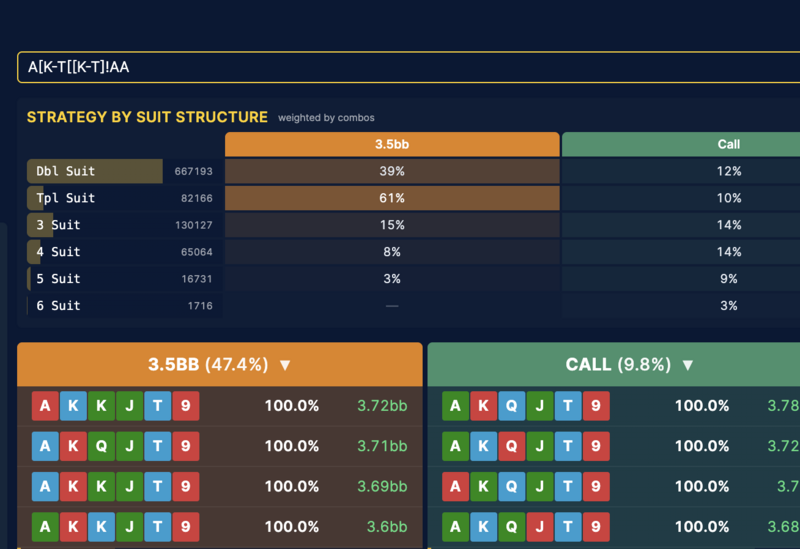 RangeConverter’s PLO6 range viewer