To practise the turn and river in poker, pick one betting line, play it against solver answers, and read what your mistakes cost in big blinds per 100 hands (bb/100). RangeConverter's GTO Trainer does this with practice sessions: runs of hands dealt only from the spots you choose. Turn and river spots have their own badges there: ten lines you can pick and drill, each with its own progress, on Hold'em cash, MTT, Spins and Short Deck sims that have postflop.
A line means a fixed betting story. The double barrel is a flop bet that was called, followed by a turn bet. It is one line and up to eight spots: you can play it as the bettor or as the player facing the bet, in position or out of position, in a single raised pot or a 3-bet pot.
Which turn and river lines can you practise?
There are ten lines, three on the turn and seven on the river. Each is named for the betting that led to it.
| Street | Line | How the hand got there |
|---|---|---|
| Turn | Double barrel | Flop bet and called |
| Turn | Barrel after a raise | Flop raised and called |
| Turn | Turn stab | Flop checked through |
| River | Triple barrel | Flop and turn both bet and called |
| River | Delayed barrel | Flop bet and called, turn checked |
| River | Triple barrel after a raise | Flop raised and called, turn bet and called |
| River | Delayed barrel after a raise | Flop raised and called, turn checked through |
| River | Barrel after a stab | Flop checked, turn bet and called |
| River | River stab | Flop and turn checked through |
| River | Bet after a turn raise | Turn bet, raised and called, after a flop bet, raise or check |
Each line comes in up to eight versions. The pot can be a single raised pot (SRP) or a 3-bet pot (3BP), you can be in position (IP) or out of position (OOP), and you can make the bet or face it. Ten lines in eight versions gives up to 80 turn and river spots on a Hold'em cash sim. MTT, Spins and Short Deck sims have fewer.
The trainer names each one in full, so "SRP: IP Double barrel" and "SRP: OOP vs Double barrel" are separate spots with separate progress.
The lines cover two-way pots. The decision to donk bet or check-raise is not drilled as a spot of its own, and multiway, 4-bet and limped pots are not dealt on the turn and river.
What can you choose in a practice session?
A practice session is a run of hands dealt only from the spots you tick. You choose the spots by street and line, the pot type, whether you are in or out of position, whether you bet or face the bet, your seat, your hands, the flops and the number of hands.
Take one leak as the example: calling too much from the big blind when the button keeps betting.
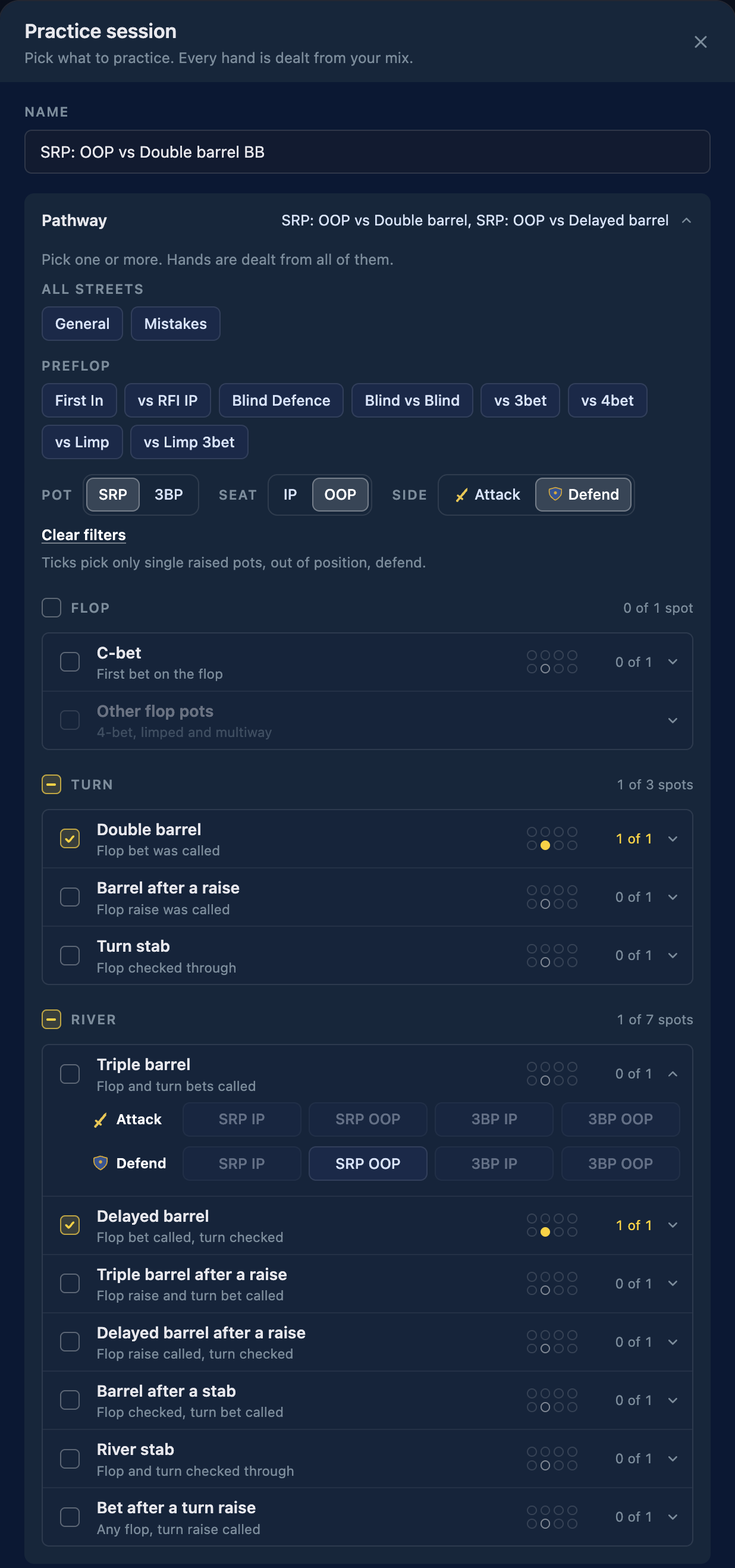
Three filters sit above the list of lines. Pot is SRP or 3BP. Seat is IP or OOP. Side is Attack (you bet or raise) or Defend (you face the bet). Set them to SRP, OOP and Defend and the builder confirms it in a line of text: "Ticks pick only single raised pots, out of position, defend."
Below the filters the lines are grouped by street. Tick a whole street to take all of its lines, or open a line and tick single versions. The preflop groups are in the same list (first in, blind defence, facing a 3-bet and the rest), so one session can mix preflop and postflop spots. The trainer deals all the spots under a tick.
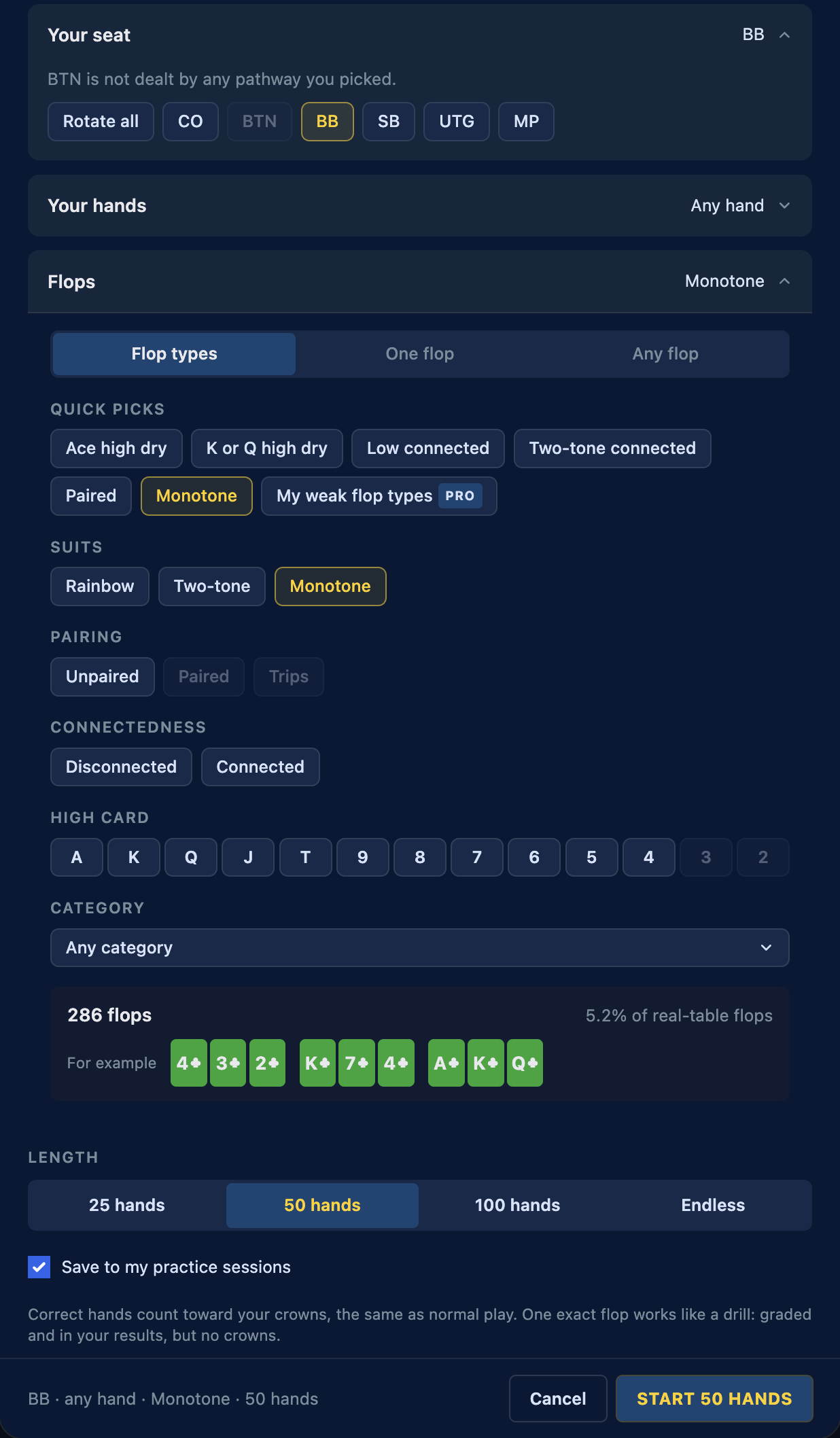
The rest of the builder narrows the deal. For your seat you can take one, several, or "Rotate all". A seat that none of your ticked lines can deal is greyed out, and the builder says why.
For your hands there are three settings. "Any hand" deals the full range. "Choose in the hand grid" lets you pick the hands yourself, for example only suited connectors. "Playable hands only" skips the trivial folds, so the session spends its hands on real decisions.
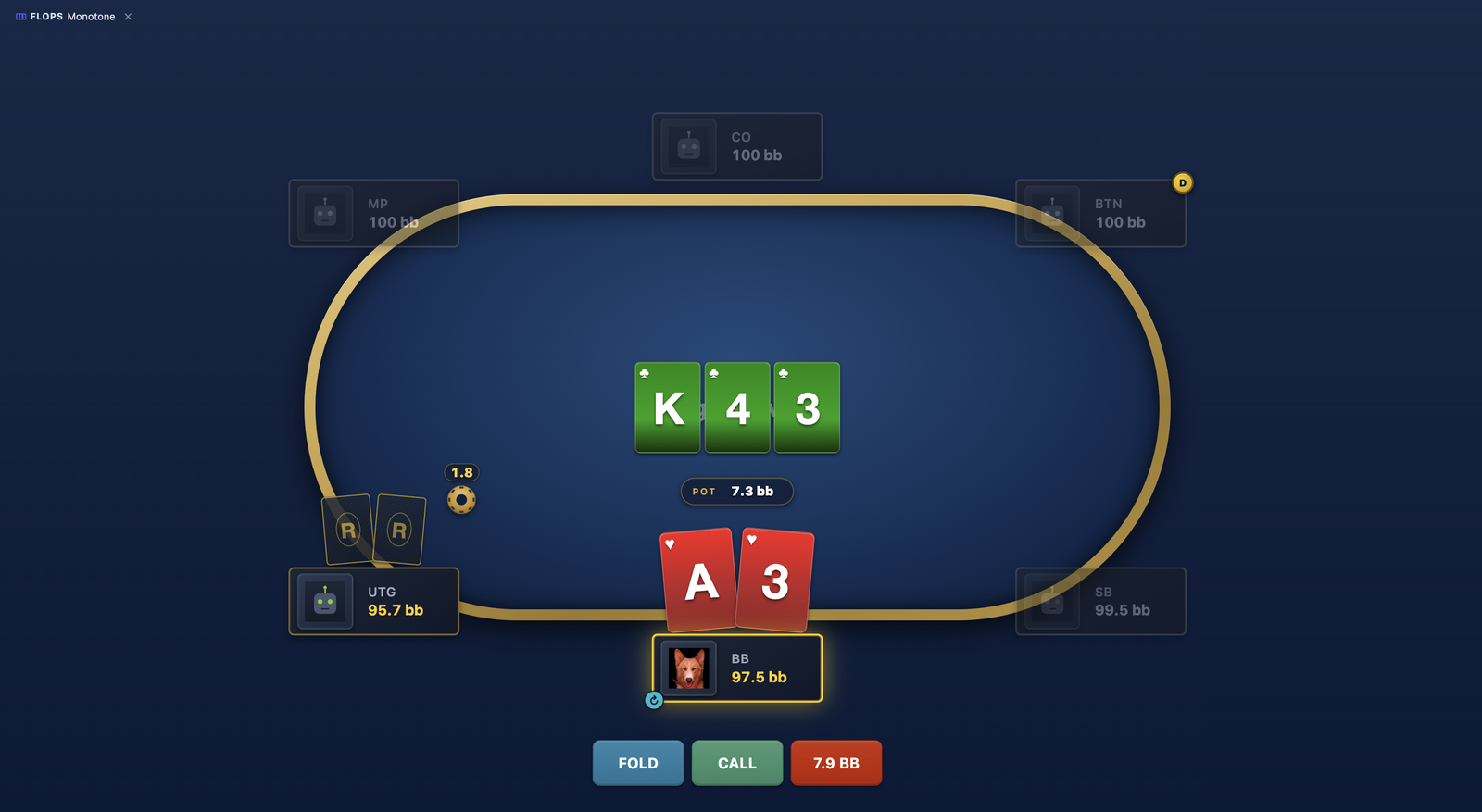
Flops can be any flop, one exact flop, or the types you choose, such as monotone, paired or low connected. With Monotone picked, the builder shows what you are getting: 286 distinct flops, 5.2% of the flops a real table deals. Flop texture odds has the full table.
A session runs for 25, 50 or 100 hands, or Endless.
Give the session a name and tick "Save to my practice sessions" and it is there next time, with its own record.
What a hand looks like
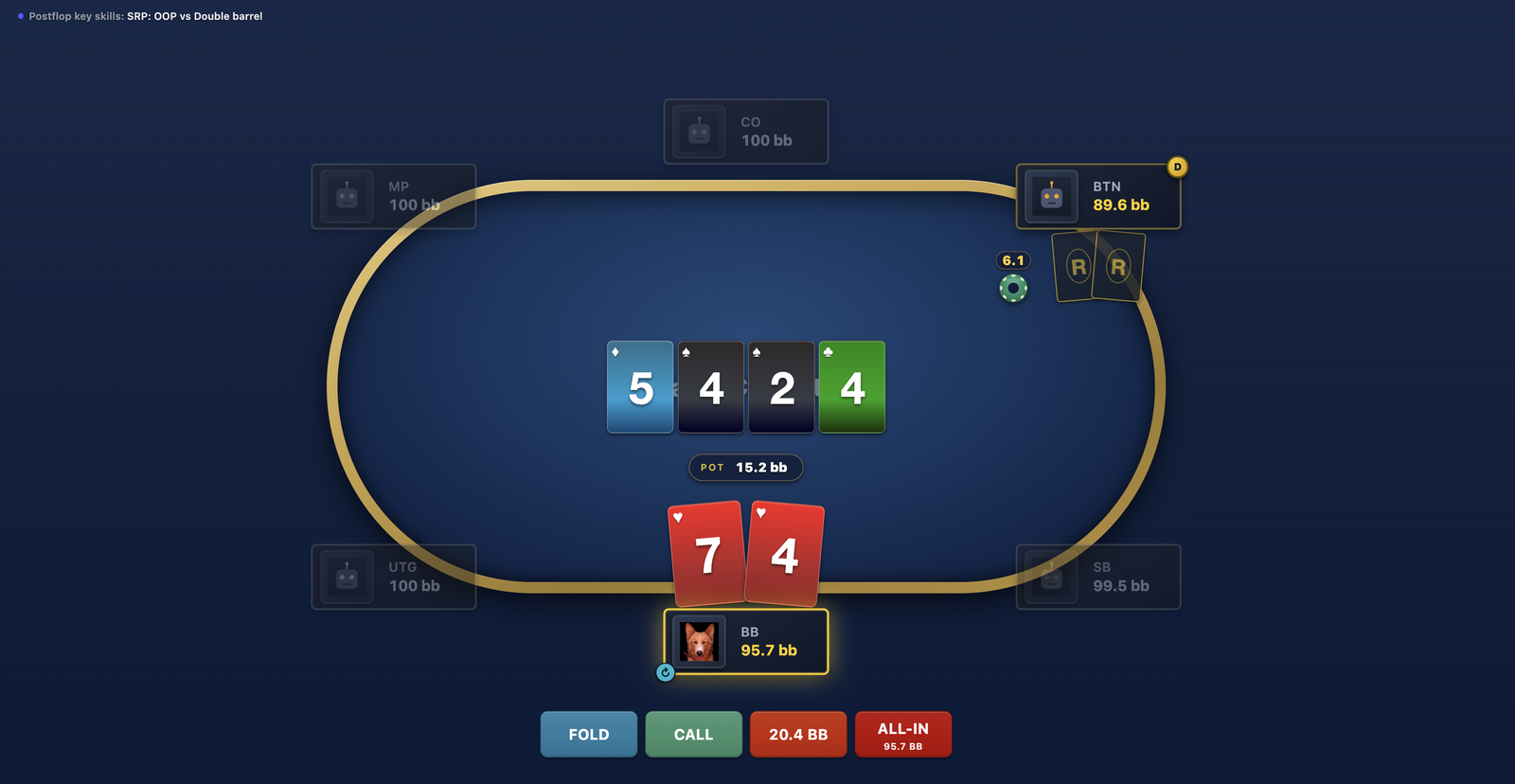
The table plays like a real one. Here the big blind holds 7♥ 4♥ on 5♦ 4♠ 2♠ with the 4♣ on the turn, and the button bets 6.1bb into a pot of 9.1bb, two thirds of the pot. The choices are fold, call, raise to 20.4bb or all-in.
After you act, the trainer shows the solver's mix and the EV of each action. In this hand the solver calls 71% of the time, raises to 20.4bb 29% and does not fold.
What do the results tell you?
The results screen tells you three things: how many of your decisions were good, how much EV you gave up in bb/100, and where it cost you most, by street and flop type.
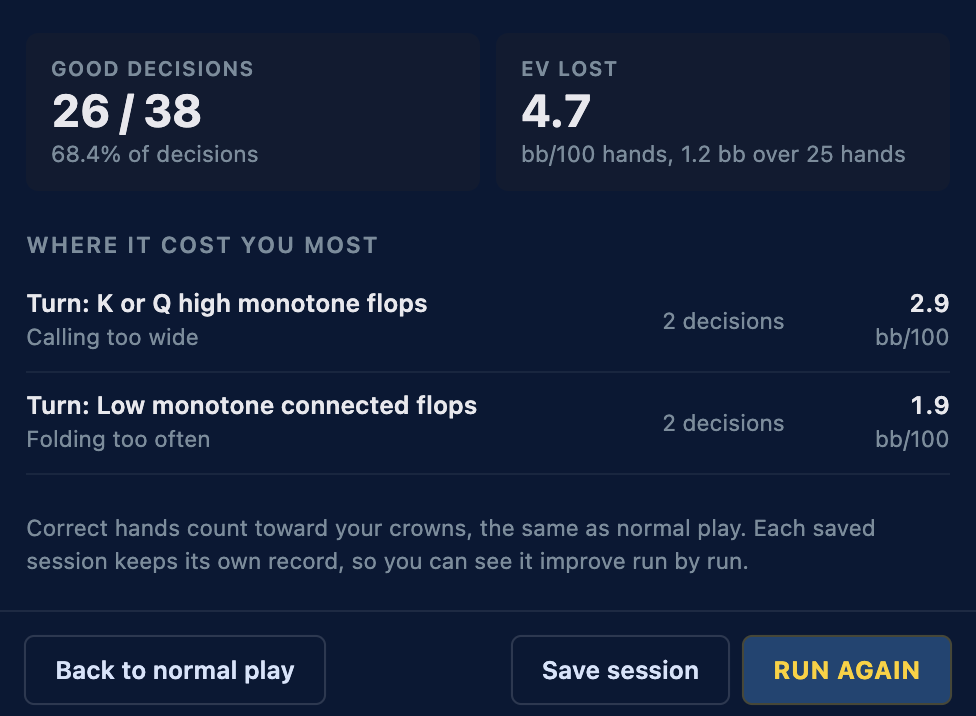
"Good decisions" counts every decision in the session, since one hand can hold several. In this run it was 26 of 38, or 68.4%.
"EV lost" is the total given up against the solver, in bb/100 of the session's hands. Here it was 4.7 bb/100, which is 1.2bb over the 25 hands. The session deals only the spots you picked, so this is not 4.7 bb/100 off your win rate: at a real table these spots come up in only a small share of your hands. Compare it with your next run of the same session.
"Where it cost you most" lists up to three places, each a street and a flop type, with a reading of what went wrong. This run showed two:
- Turn, K or Q high monotone flops: calling too wide. 2 decisions, 2.9 bb/100.
- Turn, low monotone connected flops: folding too often. 2 decisions, 1.9 bb/100.
The readings are "Folding too often", "Calling too wide" or "Bet too big with these hands". Two decisions is thin evidence, so the useful button is "Run again". A saved session keeps its own record, and you can watch the number move run by run.
The Reg plan has the whole trainer for one game, turn and river lines included.
How the skill tree picks your next line
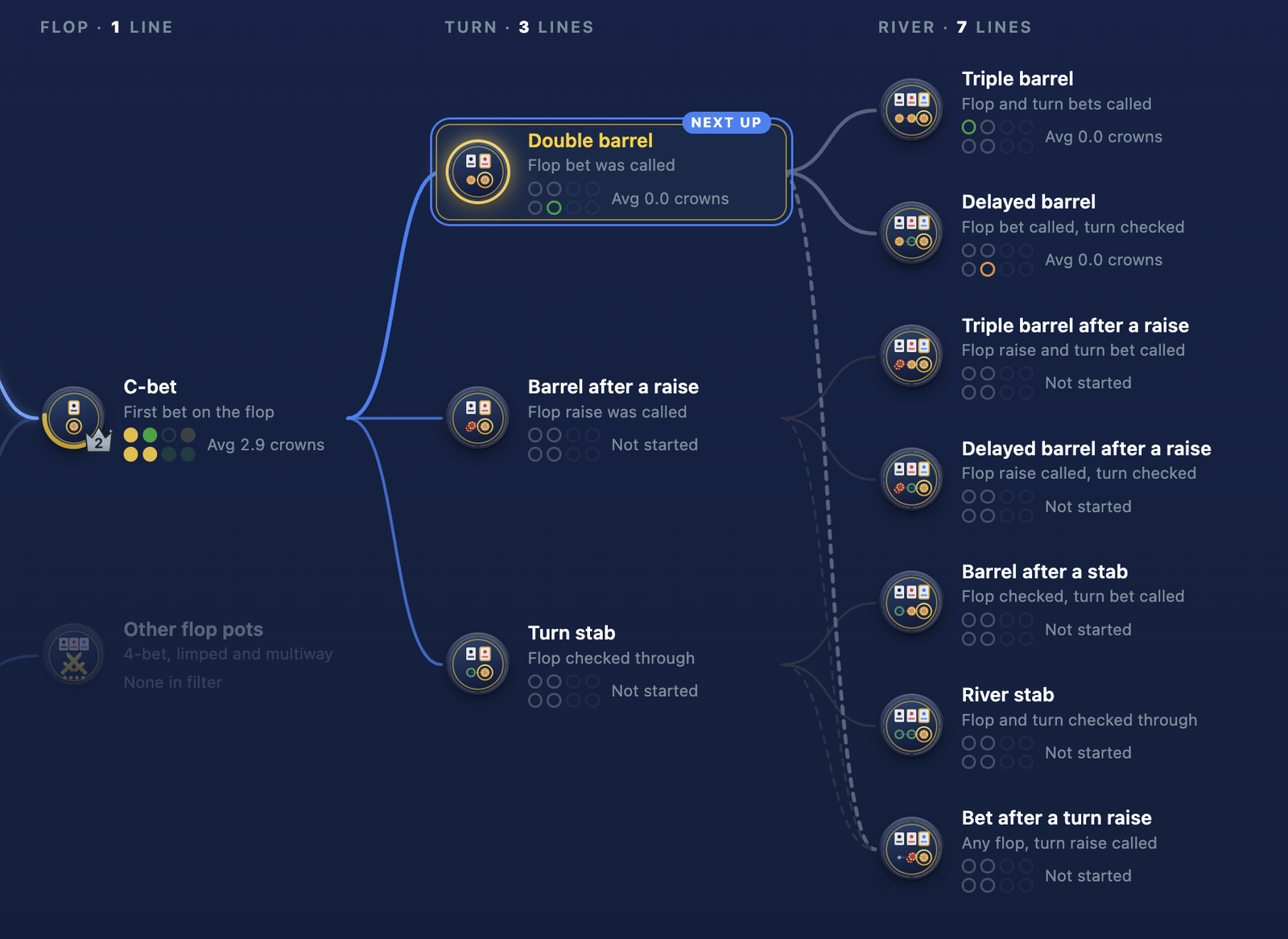
If you would sooner be told what to play, open the skill tree from the Progress tab in Hand history. It lays the lines out in order: the flop c-bet first, then the three turn lines, then the seven river lines.
Progress is counted in crowns. A crown is a mark you earn on one spot by playing it correctly, up to five for each spot. A line opens once all the lines before it average 2 crowns. The "Next up" tag sits on the open line with the lowest average and moves on when that line reaches 3.
"Play this line" opens the builder with all of that line's spots ticked and 25 hands set. The same pot, seat and side filters work on the tree, so you can look only at, say, 3-bet pots out of position.
Correct hands in a practice session count toward your crowns, the same as normal play.
Choosing the flops
Choose flops works in normal play as well as in practice sessions. There are six quick picks (Ace high dry, K or Q high dry, Low connected, Two-tone connected, Paired, Monotone), or you can build a type from suits, pairing, connectedness and high card. "One flop" deals a single exact flop every hand. That works like a drill: the hands are graded and appear in your results, but they earn no crowns.
Pro has one more pick, "My weak flop types". It finds the three flop types where your decisions lost the most EV, once you have at least 20 decisions on a type, and deals those.
Which plan do you need?
The turn and river lines need a sim with postflop, which means a paid plan: Reg or Pro. A free account has preflop sims in several games. Grading and practice sessions work on them, so you can try the builder at no cost.
Reg for Hold'em cash is $29 a month or $239 a year. It includes the whole GTO Trainer for that game: preflop drills, postflop drills, the turn and river lines, the skill tree, practice sessions and Choose flops.
Pro for Hold'em cash is $99 a month or $799 a year. It adds the postflop Range Viewer, aggregated reports, "My weak flop types" and custom solves, where you set your own bet sizes and lock hands on a turn or river spot.
Practice sessions also work on PLO sims. The turn and river lines do not.
Start with one line
The double barrel is the first turn line on the tree and a sound place to begin. Facing a double barrel works through one spot with the solver's numbers, and the GTO Trainer guide covers the controls.
To try the practice session builder on the free preflop sims, create a free account.
FAQ
Can I practise turn and river spots for free?
No. A free RangeConverter account has preflop sims only, with grading and practice sessions on those. Turn and river lines need a sim with postflop, and those start with the Reg plan.
Which games have turn and river lines?
Hold'em cash, MTT, Spins and Short Deck sims that have postflop. PLO sims have practice sessions but no turn and river lines.
How many hands should a practice session have?
The default is 25 hands, and 50, 100 and Endless are the other settings. A short session on one line, run again several times, shows whether the same street and flop type keeps costing you.
What does EV lost in bb/100 mean?
It is the expected value you gave up against the solver's best action, scaled to 100 hands. A session that loses 1bb over 25 hands shows 4 bb/100. More on EV in expected value in poker.