Node locking means fixing part of one player's strategy at one decision point in a solver, then solving again so the rest of the game adjusts to it. The output is the best play against an opponent who plays the locked hands your way and plays everything you left free as well as possible. It is a different thing from the equilibrium, which assumes both players play without mistakes.
Players use it to answer one kind of question: "my opponents do X here, so what should I change?" This post takes one lock from start to finish in RangeConverter's viewer, with the numbers before and after.
The spot before the lock
The sim is "6max 100bb 500z" in RangeConverter's viewer: six-max cash, 100bb deep. The button opens to 2.5bb and the big blind calls. The flop is K♥ 7♦ 2♣. The big blind checks, the button bets 1.8bb and the big blind calls. The turn is the 9♠ and the big blind checks. The pot is 9.1bb.
Before the lock, the simulation has the button play the turn like this.
| Button's turn action | Frequency |
|---|---|
| Check | 53.64% |
| Bet 3bb | 1.94% |
| Bet 6.1bb | 15.28% |
| Bet 13.6bb (1.5 times pot) | 29.15% |
The 13.6bb bet is the interesting one. Of those bets, 43.0% are hands with no pair and no ace. Another 13.7% are ace high.
The lock
Suppose the button gives up on the turn with every hand that has no pair and no ace.
To model that, all of those hands are locked to check: 128 combinations, each marked with a padlock. Every other hand is left free, and the turn is solved again. The solver still decides whether each free hand bets. It still checks most pocket pairs that missed, from QQ down to 33.
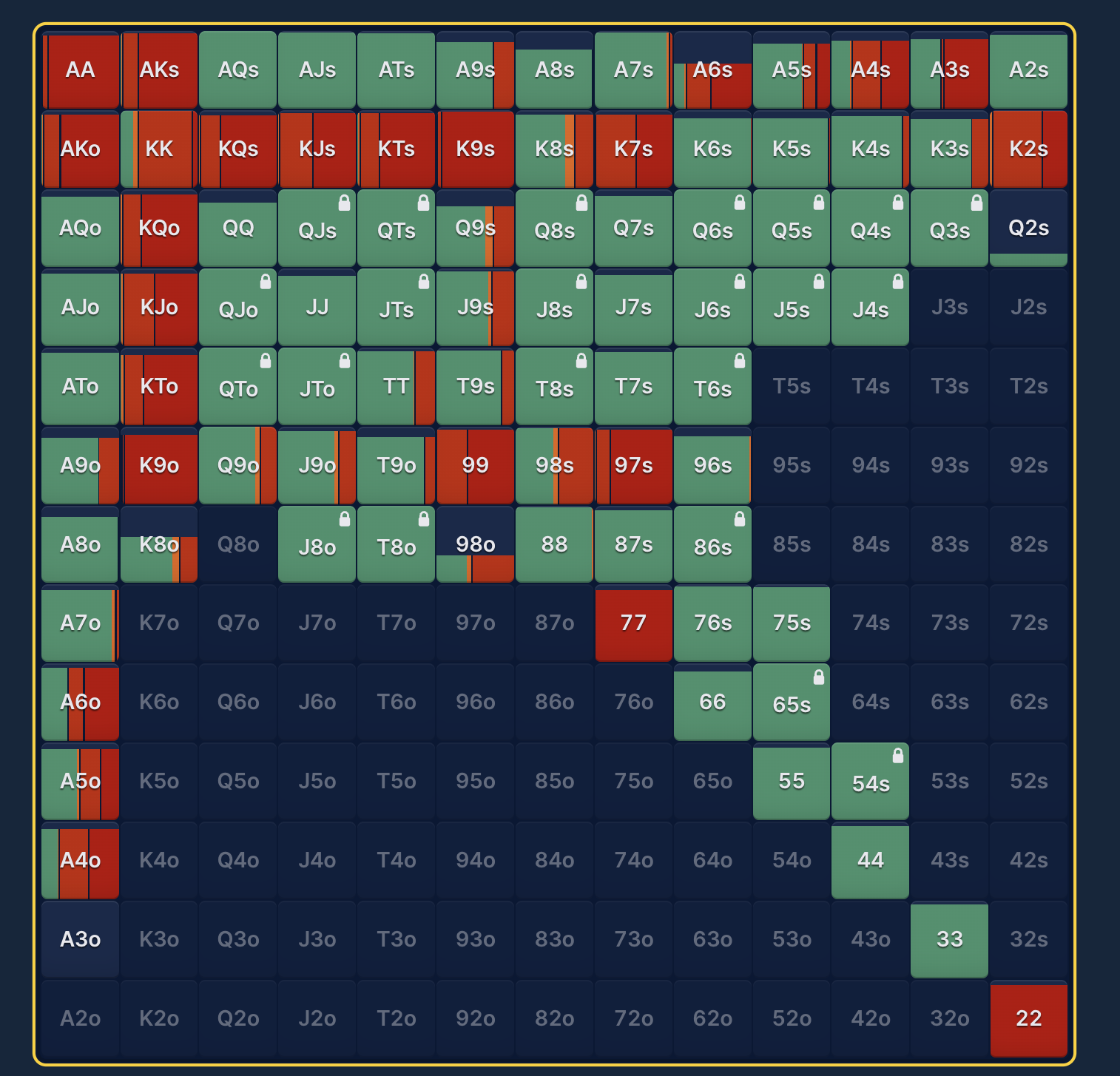
What changed after the lock?
The big blind folds more to the 13.6bb bet, but only by 7.45 points: from 60.01% to 67.46%.
| Big blind vs 13.6bb | Simulation | With the lock | Change |
|---|---|---|---|
| Fold | 60.01% | 67.46% | +7.45 |
| Call | 37.18% | 30.95% | -6.23 |
| Raise | 2.81% | 1.59% | -1.22 |
Folding more is what you would expect once those hands stop betting. The size of the move is the surprise. Hands that made up 43% of the big bets were taken out, and the fold rate moved by only 7.45 points.
The cause is on the button's side. The lock fixed the hands with no pair and no ace, and nothing else, so the solver was free to rebuild the button's betting range from what was left. It moved the bluffs to ace high. Those hands were 13.7% of the 13.6bb bets before the lock and 46.35% after it. Hands with no pair and no ace went to 0%.
So the model no longer describes an opponent who under-bluffs. It describes one who bluffs with different cards. If your read is "this player pool does not bluff turns enough", locking one class of hand does not say that. You would lock the ace high hands too, or every hand that bets.
That is the thing to know before you trust a lock. The solver obeys the lock exactly and then plays as well as it can with all that you left open.
Which hands moved most?
Q7s moved most. It called 12.12% of the time before the lock and 87.46% after it, while the pairs with an ace kicker went the other way.
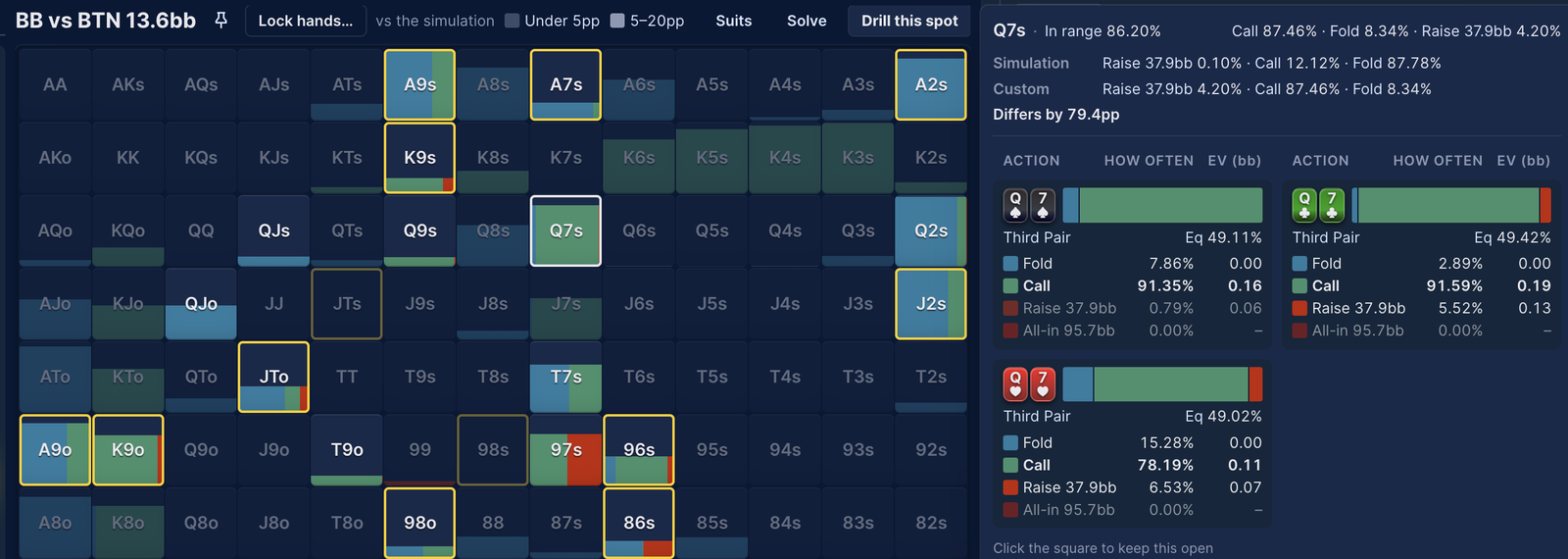
| Big blind hand | Simulation | With the lock |
|---|---|---|
| Q7s | Call 12.12% | Call 87.46% |
| A9s | Call 77.00% | Call 32.44% |
| A9o | Call 76.07% | Call 33.30% |
| A7s | Call 55.49% | Call 11.40% |
| K9s | Raise 45.74% | Raise 17.35% |
The big blind's range folds more overall, and yet Q7s goes from a fold to a call. A9s and A7s go the other way.
Can you see why? Look again at which hands the button now bluffs with.
The cards each hand removes from the button's range probably explain it. Before the lock, many of the bluffs were queen high and jack high hands, so a queen in your hand made a bluff less likely. After the lock the bluffs are ace high, so an ace in your hand does that, and a queen removes nothing. This is a reading of the output. The solver reports frequencies and gives no reasons.
A player adjusting by feel may have folded more across the board and missed all of this.
How much evidence do you need before you lock?
More than most players have on one opponent. A lock is only as good as the read behind it, and small samples support very wide ranges of truth. Say you have seen a player fold to a turn bet 60% of the time. The table shows the 95% range for the real figure (Wilson interval) at each sample size.
| Times you saw the spot | Observed | The real figure is likely between |
|---|---|---|
| 10 | 60% | 31% and 83% |
| 20 | 60% | 39% and 78% |
| 50 | 60% | 46% and 72% |
| 100 | 60% | 50% and 69% |
| 300 | 60% | 54% and 65% |
| 1,000 | 60% | 57% and 63% |
After seeing the spot 20 times, "folds 60%" fits a player who folds 39% and one who folds 78%. Those two players need opposite adjustments. For one opponent you will seldom have enough hands in one exact spot. Locks are on firmer ground when they describe a whole player pool across thousands of hands, or when you use them to learn how a strategy bends, as in the example above.
Node locking in RangeConverter
Custom solves are in RangeConverter's Pro plan and work on heads-up turn and river spots, on Hold'em cash, MTT, Short Deck and Spins sims that have postflop in the viewer.
Open a turn or river spot in the Range Viewer and press Solve. You can set your own bet sizes, lock hands and choose the accuracy. The solver works it out.
"Differences" then shows where the custom solve departs from the simulation, hand by hand, as in the Q7s picture above.
Each Pro account can run 20 custom solves every 24 hours, one at a time.
The scope is narrow: heads-up pots, turn and river only, and not PLO. Inside that scope, a lock starts from a simulation you already study, in the same viewer, with that simulation's ranges and bet sizes as the starting point.
Pro for Hold'em cash is $99 a month or $799 a year.
Practise the adjustment
Knowing the adjusted strategy and playing it are separate skills. A spot from the viewer can be sent to the GTO Trainer with "Drill this spot", and on a custom solve the trainer grades your hands against the custom solve.
For this spot without the lock, facing a double barrel covers what the simulation does, and practise the turn and river one line at a time shows how to build a session around it. The trainer is in the Reg plan. Custom solves need Pro.
FAQ
What is node locking in poker?
Node locking is fixing some or all of one player's strategy at a decision point in a solver and then re-solving. The solver then finds the best play for both players, with the locked hands held to your choice.
Is a node-locked solution GTO?
No. GTO play assumes neither player makes mistakes. A node-locked solution is the best play against an opponent who plays the locked hands your way and everything else as well as possible. Most real players do not adjust the rest like that, so against them you can win more than the solution shows. Against an opponent who does not play the way you locked, it can do worse than GTO.
How many hands do you need before node locking?
More than most players have on one opponent. If a player folded 12 of the 20 times you saw the spot, the real figure is likely between 39% and 78%. After 300 times the range is 54% to 65%.
Can you lock some hands and not the whole range?
Yes. In RangeConverter you lock only the hands you choose at that point. Be aware that the solver will re-optimise all the hands you leave free, which can cancel part of the effect you meant to model.
Which RangeConverter plan has node locking?
Pro. Custom solves with your own bet sizes and locked hands work on heads-up turn and river spots in Hold'em cash, MTT, Short Deck and Spins. They are not available for PLO.