There are 22,100 possible flops in Texas Hold'em. A monotone flop (three cards of one suit) comes 5.18% of the time, about 1 in 19. A paired flop comes 16.94% of the time, about 1 in 6. A two-tone flop (two cards of one suit) is the most common suit pattern at 55.06%, and a rainbow flop (three suits) comes 39.76% of the time.
These flop texture odds are exact counts. The tables below give the probability of each texture, then what the solver does on each one in a RangeConverter 6-max cash sim.
How often does each flop texture come?
The most common texture is an unpaired two-tone flop, at 46.59% of all flops. The rarest is three of a kind, at 0.24%.
| Flop texture | Flops | Share | Roughly |
|---|---|---|---|
| Unpaired, two-tone | 10,296 | 46.59% | 1 in 2.1 |
| Unpaired, rainbow | 6,864 | 31.06% | 1 in 3.2 |
| Paired, two-tone | 1,872 | 8.47% | 1 in 12 |
| Paired, rainbow | 1,872 | 8.47% | 1 in 12 |
| Monotone | 1,144 | 5.18% | 1 in 19 |
| Trips | 52 | 0.24% | 1 in 425 |
| All flops | 22,100 | 100% |
Grouped by suits alone, 55.06% of flops are two-tone, 39.76% are rainbow and 5.18% are monotone. Grouped by pairing alone, 82.82% are unpaired, 16.94% are paired and 0.24% are trips.
How are the odds counted?
A flop is three cards from 52, and the order does not matter: 52 × 51 × 50 / 6 = 22,100. Each texture is a count of those flops.
Monotone: choose 3 ranks from 13 (286 ways) and one of 4 suits. 286 × 4 = 1,144.
Paired: choose the paired rank (13), two of its four suits (6), then a third card of another rank (12 ranks × 4 suits). 13 × 6 × 12 × 4 = 3,744.
Trips: 13 ranks × 4 ways to leave one suit out = 52.
Unpaired rainbow: three different ranks (286 ways) with three different suits in order (4 × 3 × 2 = 24). 286 × 24 = 6,864.
Unpaired two-tone is what remains: 22,100 less 1,144, 3,744, 52 and 6,864 = 10,296.
These are odds for a full deck before you look at your hand. Short Deck uses 36 cards, so its shares are different.
What are the odds that the flop helps your hand?
With two suited cards you flop a flush 0.84% of the time and a flush draw 10.94%. A pocket pair flops a set or better 11.76% of the time. Once you hold two cards, the flop comes from the other 50, which makes 19,600 possible flops.
| You hold | The flop gives you | Odds |
|---|---|---|
| Two suited cards | A flush | 0.84% (1 in 119) |
| Two suited cards | A flush draw | 10.94% (about 1 in 9) |
| A pocket pair | A set or better | 11.76% (about 1 in 8.5) |
| Two unpaired cards | At least one pair with a hole card | 32.43% (about 1 in 3) |
The flush figure is 165 flops of 19,600: 3 cards from the 11 left in your suit. The flush draw is 55 × 39 = 2,145 flops: 2 of those 11 cards and 1 of the 39 cards in other suits.
How does the solver play each flop texture?
In a 6-max 100bb cash solve, the button c-bets 65.6% of flops overall, from 99.9% on trips down to 46.1% on monotone flops. The spot is button against big blind in a single raised pot: the button opens 2.5bb, the big blind calls and checks the flop. The figures come from the Flop report in RangeConverter's Pro viewer, on the "6max 100bb 500z" sim.
| Flop texture | Button c-bets | Button checks | Big blind folds to a third-pot bet |
|---|---|---|---|
| Trips | 99.9% | 0.1% | 36.6% |
| Paired, rainbow | 73.5% | 26.5% | 38.9% |
| Unpaired, rainbow | 71.1% | 28.9% | 34.1% |
| Paired, two-tone | 68.2% | 31.8% | 37.6% |
| Unpaired, two-tone | 62.1% | 37.9% | 33.1% |
| Monotone | 46.1% | 53.9% | 34.5% |
The 65.6% is the average across all flops, weighted by how often each texture comes.
Monotone flops are the one texture where the button checks more than it bets. When it does bet, it bets small: 37.3 of its 46.1 points are the third-pot size, and the full-pot bet is used 0.7% of the time. The big blind also raises least here, at 7.8%, against 14.0% on unpaired rainbow flops and 20.2% on paired rainbow flops.
The high card moves the number as much as the suits do. The table shows how often the button c-bets on unpaired flops.
| Highest card (unpaired flops) | Monotone | Two-tone | Rainbow |
|---|---|---|---|
| Ace | 36.0% | 54.9% | 61.6% |
| K or Q | 44.6% | 68.9% | 80.9% |
| J, T or 9 | 50.7% | 64.3% | 74.7% |
| 8 or lower | 58.4% | 50.9% | 52.2% |
On K or Q high rainbow flops the button bets 80.9% of the time. On ace high monotone flops it bets 36.0%. One flat c-bet frequency cannot serve both. A player who bets 65.6% on every flop is within 5 points of the solver on 31.4% of flops and more than 10 points away on 45.7% of them.
These tables come from the Flop report in the Pro viewer, for this one spot. The free 6-max 100bb flop report is a general guide to flop play on the same sim and does not hold them.
Why the mix of flops in a trainer matters
Solvers save work by treating flops that differ only by a swap of suits as one. That leaves 1,755 strategically distinct flops. One distinct monotone flop stands for 4 real flops. One distinct unpaired rainbow flop stands for 24.
A trainer that deals each of the 1,755 with equal chance gets the mix wrong.
| Per 1,000 flops | Equal chance for each distinct flop | A real deck |
|---|---|---|
| Monotone | 163 | 52 |
| Unpaired rainbow | 163 | 311 |
| Paired | 178 | 169 |
You would see three times as many monotone flops as a real table deals, and about half the unpaired rainbow flops. Your practice results would then lean toward boards you seldom meet.
RangeConverter's GTO Trainer deals Hold'em flops at real-table odds: each distinct flop is weighted by the number of real deals it stands for.
How to practise one flop texture at a time
Real-table odds are right for general play and slow for fixing one weakness. At 5.18%, a monotone flop turns up about once in 19 hands. Choose flops in RangeConverter's GTO Trainer deals only the type you ask for.
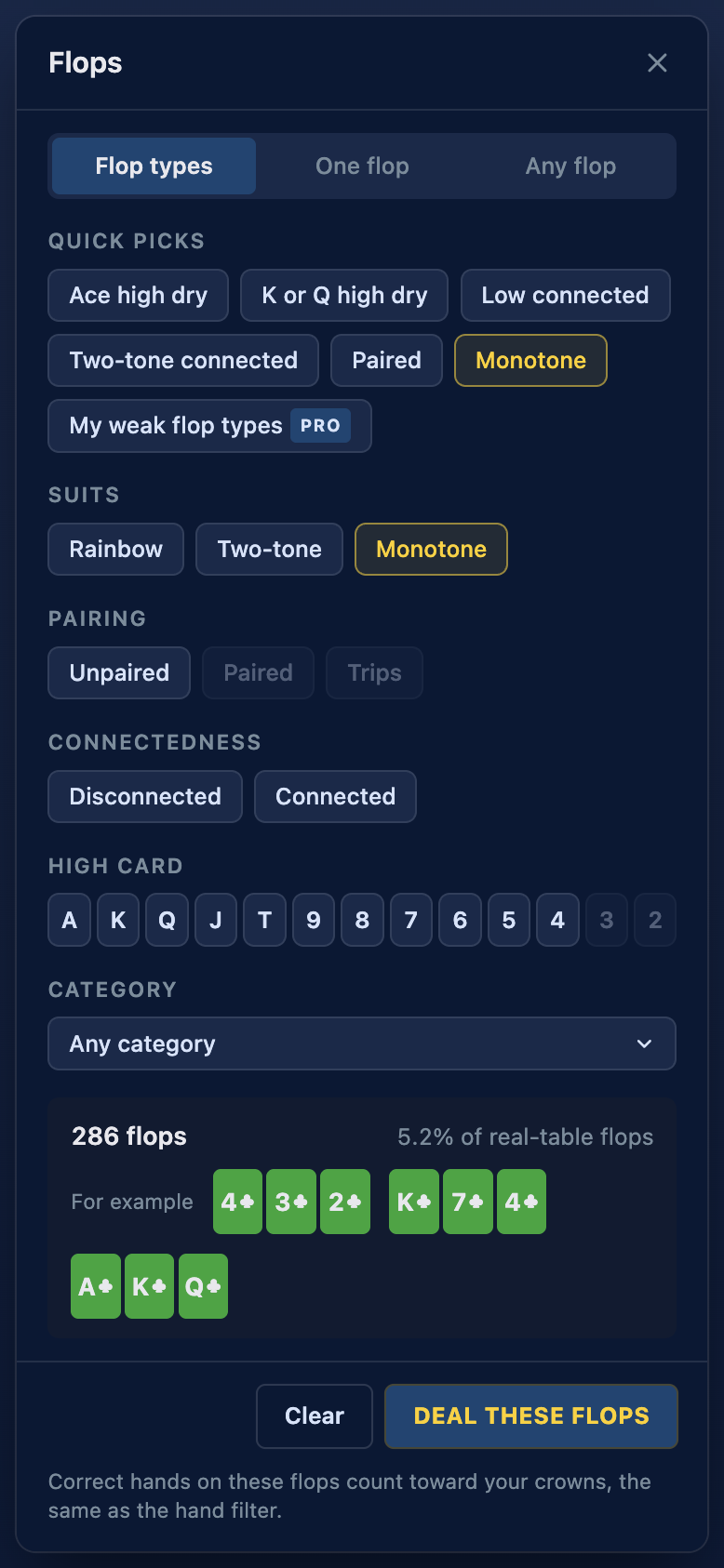
The panel counts distinct flops, so Monotone shows 286. Each stands for four real flops, one for each suit, which gives the 1,144 in the table above.
There are six quick picks: Ace high dry, K or Q high dry, Low connected, Two-tone connected, Paired and Monotone. You can also build a type from four settings: suits, pairing, connectedness and high card. "K or Q high, rainbow, unpaired" is one such type. The "One flop" tab deals a single exact flop every hand.
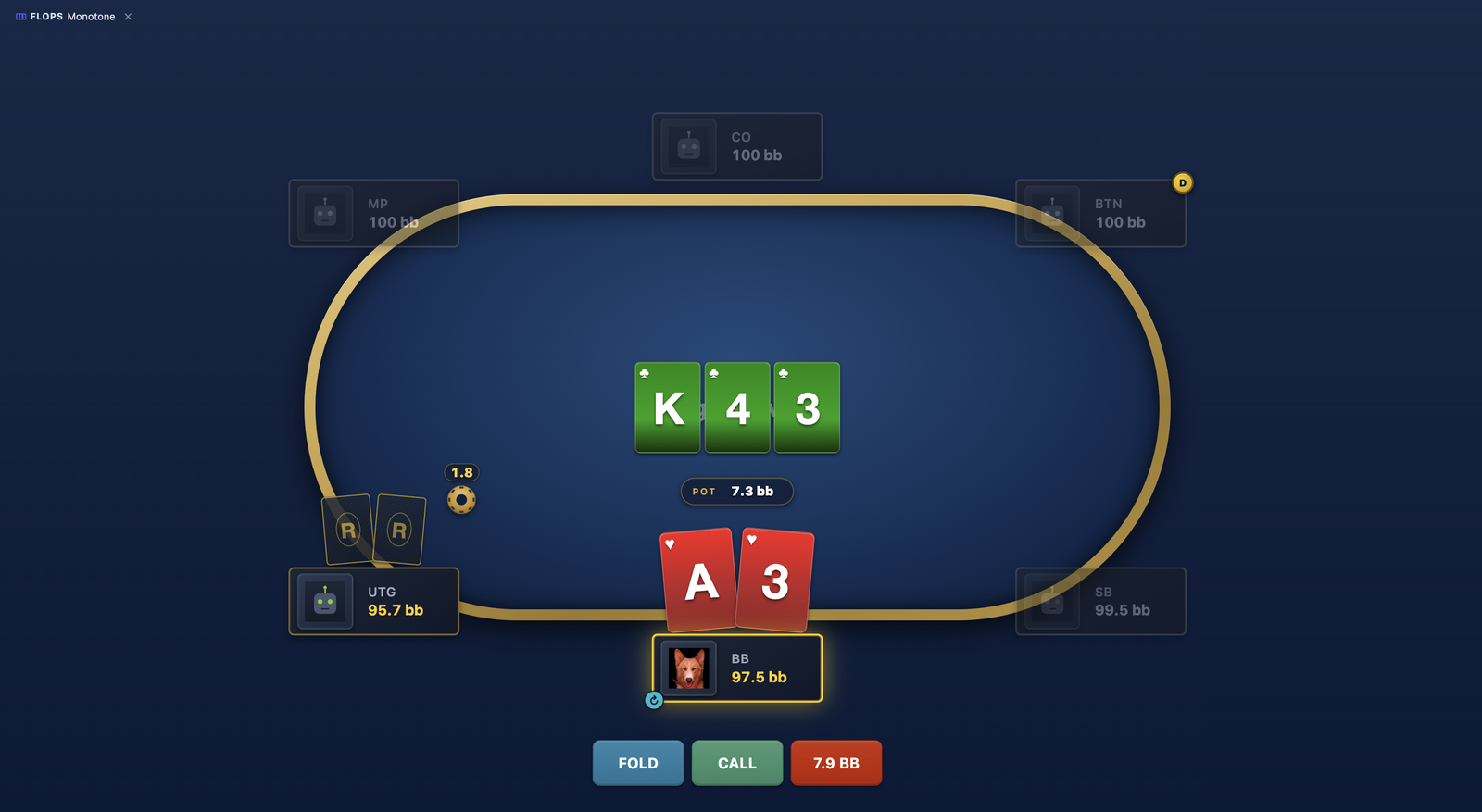
Choose flops works in normal play and inside a practice session, where you can pair a flop type with one betting line. Correct hands on chosen flop types count toward your progress as usual.
Choose flops is part of the Reg plan.
Let the trainer find your weak textures
Pro adds a pick called "My weak flop types". It looks at your scored decisions, finds the three flop types where you lost the most EV, and deals those. A type needs at least 20 decisions before it can be counted.
Practice session results use the same grouping. A result line reads, for example, "Turn: K or Q high monotone flops, calling too wide, 2.9 bb/100".
FAQ
How often is the flop monotone?
A monotone flop comes 5.18% of the time in Texas Hold'em, about 1 in 19 flops. That is 1,144 of the 22,100 possible flops.
How often is the flop paired?
A paired flop comes 16.94% of the time, about 1 in 6. That is 3,744 of 22,100 flops. Three of a kind on the flop is a further 0.24%, or 1 in 425.
How often is the flop rainbow?
A flop has three different suits 39.76% of the time. Unpaired rainbow flops alone are 31.06%.
How many different flops are there in poker?
There are 22,100 possible flops in Texas Hold'em. Treating flops that differ only by suit names as the same leaves 1,755 strategically distinct flops.
How often should you c-bet a monotone flop?
In a 6-max 100bb solve, button against big blind in a single raised pot, the button bets 46.1% of monotone flops and checks 53.9%. Most of those bets are a third of the pot.