A double barrel is a turn bet from the player who bet the flop and was called. How often you should fold to one depends first on the size of the bet. In RangeConverter's 6-max 100bb cash solve, on K♥ 7♦ 2♣ with the 9♠ on the turn, the big blind folds 60.0% of its range to a bet of 1.5 times the pot and continues with 40.0%. Minimum defence frequency (MDF), the pot arithmetic, gives almost the same answer: 40.1%.
Most advice on the double barrel is written for the player firing it. This post takes the other seat.
How often should you defend, by bet size?
Against a turn bet of two thirds of the pot, minimum defence frequency (MDF) says to continue with at least 60% of your range. Against a pot-sized bet it says 50%, and against 1.5 times the pot, 40%. MDF is the share of your range you must continue with so that a bluff with any two cards does not show an automatic profit.
The formula uses the pot before the bet:
MDF = pot / (pot + bet)
| Turn bet | MDF | Fold rate at MDF | Equity a call needs |
|---|---|---|---|
| One third pot | 75.0% | 25.0% | 20.0% |
| Half pot | 66.7% | 33.3% | 25.0% |
| Two thirds pot | 60.0% | 40.0% | 28.6% |
| Three quarters pot | 57.1% | 42.9% | 30.0% |
| Pot | 50.0% | 50.0% | 33.3% |
| 1.5 times pot | 40.0% | 60.0% | 37.5% |
| Twice pot | 33.3% | 66.7% | 40.0% |
The last column is the pot odds: bet / (pot + two bets). Against a pot-sized bet you risk 1 to win 2, so a call needs 33.3%.
MDF is a guide, not a limit, and the solver does not follow it to the decimal. A weak call can still lose to a bluff that improves, and it often faces a river bet it must fold. So folding more than MDF can be right, most of all before the river. The solver defends more when its range is strong on the board and clearly less when it is weak. In the spot below the two land within a fraction of a point.
The spot
The sim is "6max 100bb 500z" in RangeConverter's viewer: six-max cash, 100bb deep. The button opens to 2.5bb and the big blind calls. The flop is K♥ 7♦ 2♣. The big blind checks, the button bets 1.8bb (a third of the pot) and the big blind calls. The turn is the 9♠ and the big blind checks again. The pot is 9.1bb.
This is the spot the trainer calls "SRP: OOP vs Double barrel": a single raised pot, you are out of position, and you face the bet.
How often does the button fire again?
On this board the button bets the turn 46.4% of the time and checks 53.6%. When it does bet, it mostly bets big.
| Button's turn action | Frequency |
|---|---|
| Check | 53.64% |
| Bet 3bb (one third pot) | 1.94% |
| Bet 6.1bb (two thirds pot) | 15.28% |
| Bet 13.6bb (1.5 times pot) | 29.15% |
The overbet is 29.15 of the 46.37 points of betting (1.94 + 15.28 + 29.15), or 63% of all the turn bets. The small bet almost disappears.
So the second barrel on this board is usually a bet of 13.6bb into 9.1bb. That is the bet to prepare for.
What is the big bet made of?
Of the button's 13.6bb bets, 43.0% are hands with no pair and no ace, and another 13.7% are ace high. Added together, 56.7% of the overbets hold no pair. The rest are value hands that want to play for stacks by the river.
A range that is more than half unpaired hands cannot be folded to at will. That is why the big blind keeps 40% of its range against a bet this large.
Which hands continue?
Against the 13.6bb bet the big blind's whole range folds 60.01%, calls 37.18% and raises 2.81%. Defence is 39.99% (37.18 + 2.81) against an MDF of 40.1% (9.1 / 22.7). The hands do not share that split evenly.
| Big blind hand | Made hand | Call | Notes |
|---|---|---|---|
| A9s | Pair of nines | 77.00% | |
| A9o | Pair of nines | 76.07% | |
| A7s | Pair of sevens | 55.49% | |
| Q7s | Pair of sevens | 12.12% | Folds 87.78% |
| K9s | Two pair | Raises 45.74% |
A7s and Q7s are the same pair of sevens. One calls more than half the time and the other folds nearly nine times in ten.
The cards each hand removes probably explain it. Many of the button's bluffs are queen high and jack high hands, such as QJ and QT. Holding a queen takes some of those bluffs out of the button's range, which leaves Q7s facing value more often. A7s removes none of them. This is a reading of the output. The solver reports frequencies and does not give reasons.
On this board, facing the overbet, the kicker beside the pair decides more than the pair does.
A smaller bet changes the answer
Against two thirds of the pot the MDF rises from 40% to 60%, and hands that were close folds become calls.
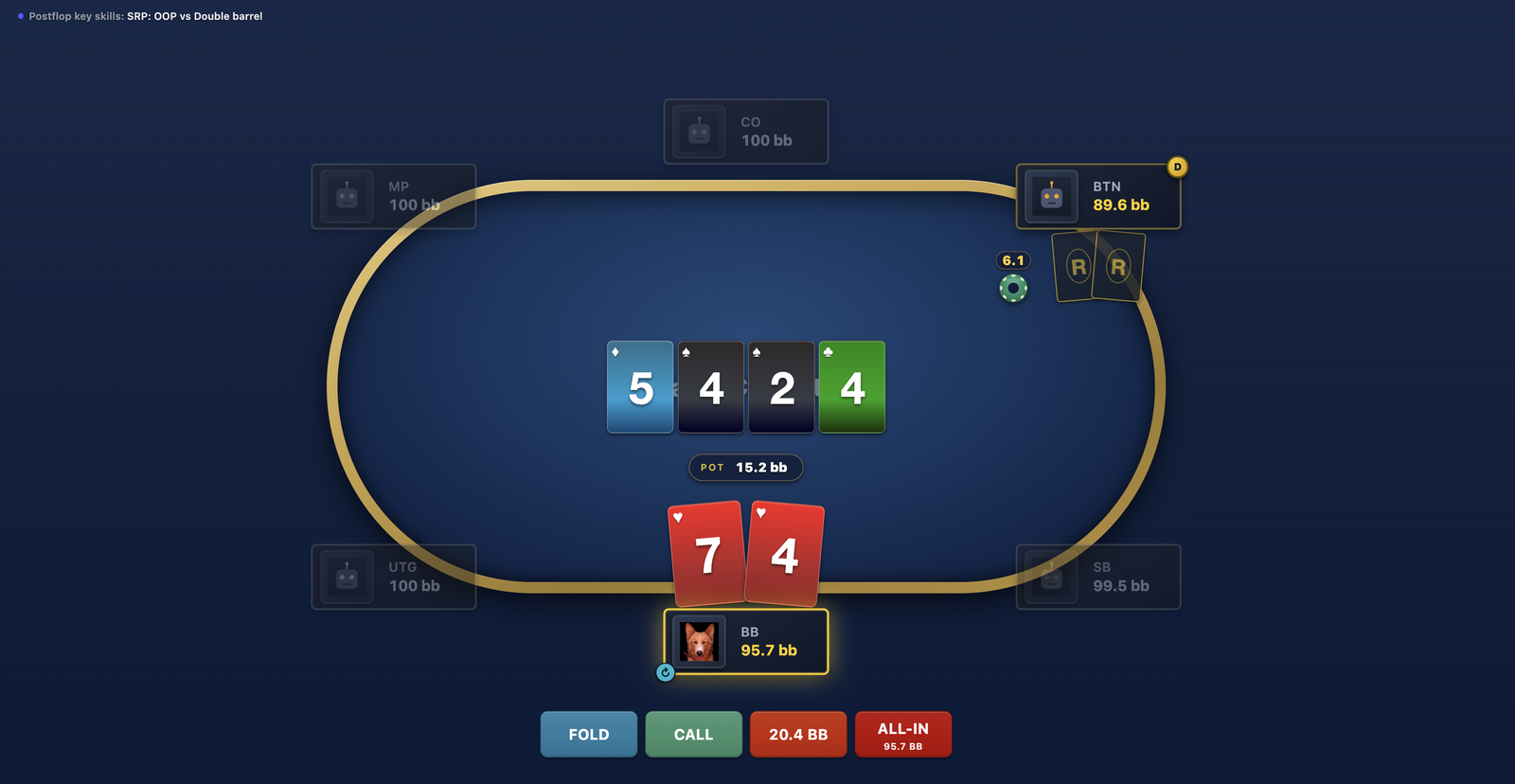
The trainer deals this size too. Here the big blind holds 7♥ 4♥ on 5♦ 4♠ 2♠ 4♣ and faces 6.1bb into 9.1bb. Trips never fold, so the question is whether to raise. The solver calls 71% and raises to 20.4bb 29%.
One line, eight versions
The numbers above belong to one version of the double barrel: single raised pot, out of position, facing the bet. There are seven more. The pot can be single raised or 3-bet, you can be in or out of position, and you can be the one betting.
They do not share answers. In a 3-bet pot both ranges are narrower and there is less money behind for the size of the pot, so the bet sizes and the defending hands change. Treat the figures in this post as true for this spot and as a starting point for the others. They also come from one flop and one turn card.
How to practise facing a double barrel
A table of frequencies is easy to read and hard to recall with a bet in front of you. RangeConverter's GTO Trainer deals this spot on its own in a practice session, and grades each decision against the solver.
Set the filters to SRP, OOP and Defend, tick Double barrel under Turn, and choose the big blind as your seat. Pick "Playable hands only" to skip the trivial folds. Leave flops on any, or choose a flop type to stay on one kind of board. The full list of settings is in practise the turn and river one line at a time.
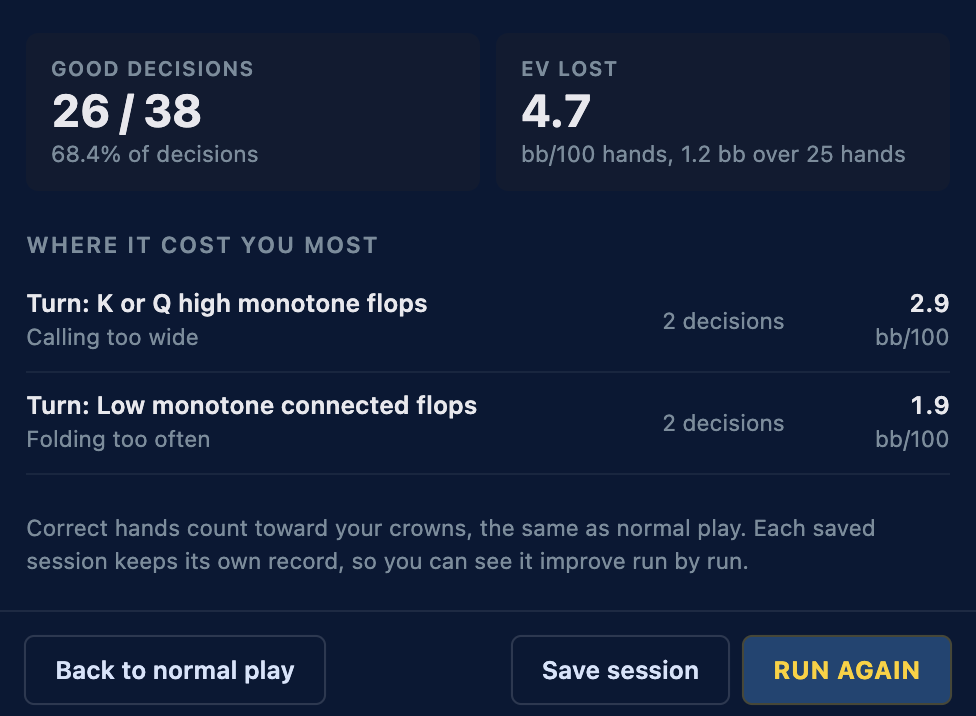
The results put a price on the leak. In the session above, 26 of 38 decisions were good and the rest cost 4.7 bb/100 of practice hands. At a real table these spots come up far less often, so the cost to your win rate is much smaller. The costliest spot was calling too wide on the turn on K or Q high monotone flops, at 2.9 bb/100. The next was the opposite error on low connected monotone flops: folding too often. One player made both mistakes on the same street, on different boards, and the session told them apart.
The double barrel line, in all eight versions, is in the Reg plan with the rest of the trainer.
Check the numbers yourself
The spot is in the postflop Range Viewer on Pro, where you can open any hand in the big blind's range and see its mix. Pro can also change the question. A custom solve with locked hands shows what happens to these calls when the button stops bluffing with its weakest hands.
If you want the flop first, the 6-max 100bb flop reports are free.
FAQ
What is a double barrel in poker?
A double barrel is a bet on the turn by the player who bet the flop and was called. The usual case is the preflop raiser betting the flop and then the turn.
How often should you fold to a double barrel?
It depends first on the bet size. Minimum defence frequency, pot / (pot + bet), gives a starting point: fold about 40% to a two thirds pot bet, 50% to a pot bet and 60% to a bet of 1.5 times the pot. It is a guide, not a limit, most of all before the river. The solver folds more when its range is weak on the board and less when it is strong. In one solved 6-max spot on K♥ 7♦ 2♣ 9♠, the big blind folds 60.01% to a 1.5 times pot bet.
Which hands should call a turn overbet?
In the solved example, pairs with an ace kicker call most. A9s calls 77% and A7s calls 55%. Q7s, the same pair as A7s, calls only 12%, probably because a queen removes some of the bettor's bluffs.
How do I practise facing a double barrel?
In RangeConverter's GTO Trainer, build a practice session with the pot, seat and side filters set to SRP, OOP and Defend, and tick Double barrel on the turn. The trainer deals only that spot and reports the EV you lost in bb/100.