Poker range viewer tutorial: Hold'em and Short Deck
Pick a spot and the Range Viewer shows you the solver's answer: every hand in the range, how often it takes each action and the EV behind each number.
This tutorial walks through the Range Viewer for Hold'em and Short Deck. PLO games open in their own viewer, covered in the PLO Range Viewer tutorial.
Open a sim
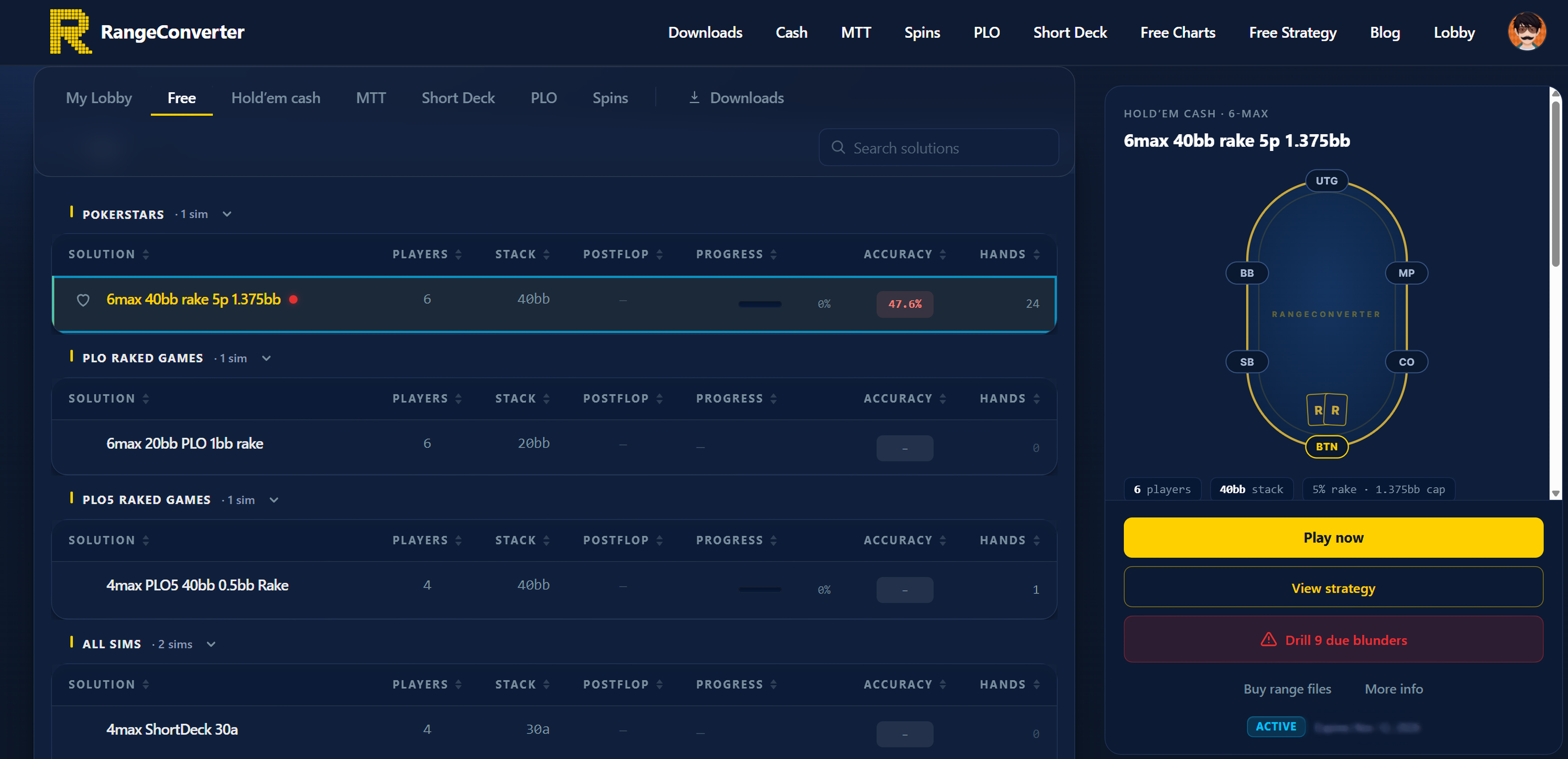
Go to My Lobby, pick a sim and press View strategy. The viewer opens at the first decision of the hand.
You can try it for free. Sign up at rangeconverter.com and confirm your email to get free preflop sims across several games, in both the Range Viewer and the GTO Poker Trainer. They sit in the Free tab of My Lobby. No credit card needed.
The first time you open the viewer, a short tour of the study screen runs by itself. Each view has its own tour too. You can replay them any time from ? at the top right.
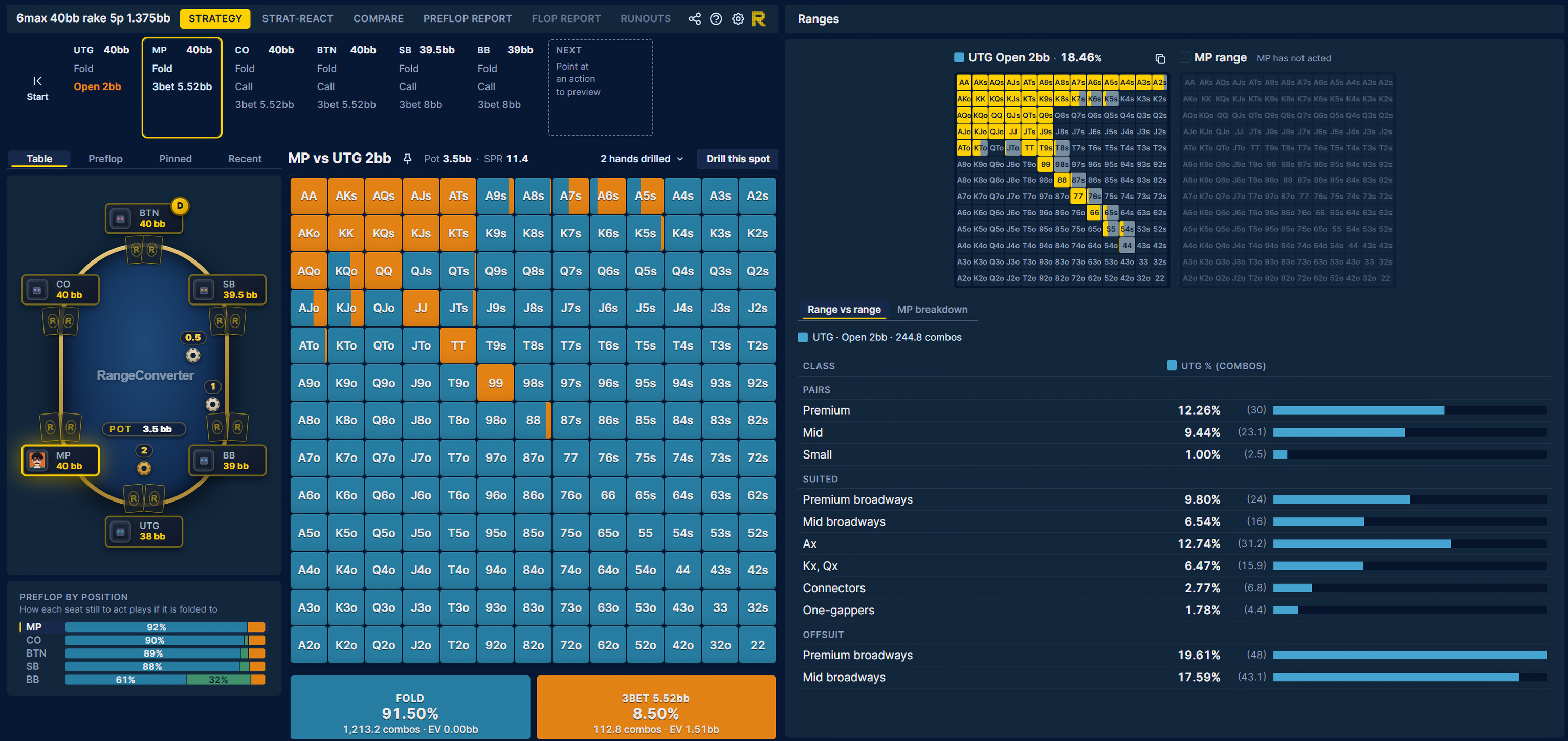
The study screen at a glance
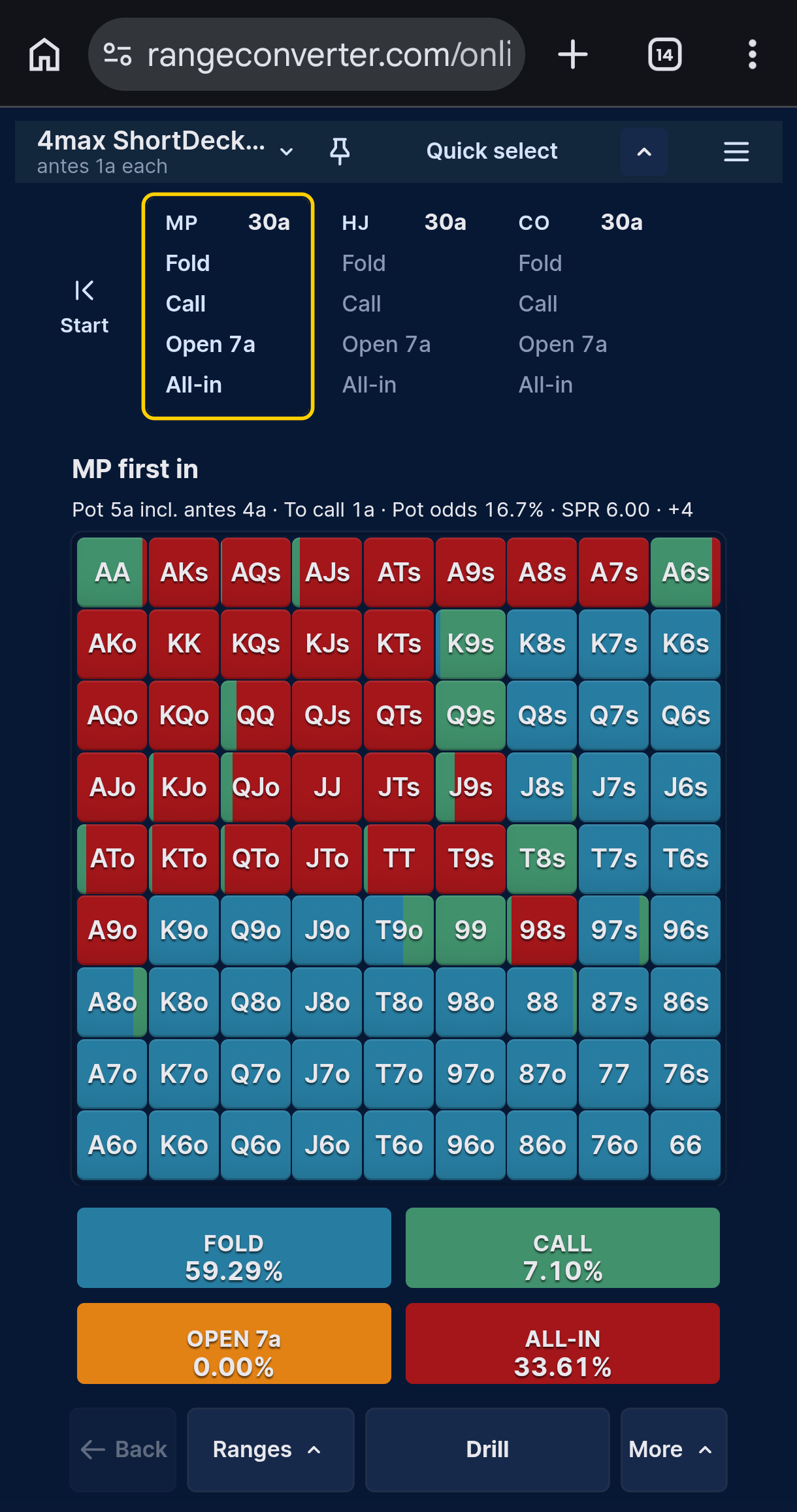
On a computer the screen has four parts:
- Top: the game tree navigation bar, one card per decision, and the views: Strategy, Strat-React, Compare, Preflop report, Flop report and Runouts.
- Left: the table and Quick select. Under the table, before the flop, Preflop by position shows how each seat still to act plays if it is folded to.
- Middle: the spot's name, the strategy grid and one button per action.
- Right: the Ranges panel.
On a smartphone, Quick select folds into a rail on the left edge, and Table and By position become buttons above the grid.
A view the spot or sim do not offer stays in place, greyed out.
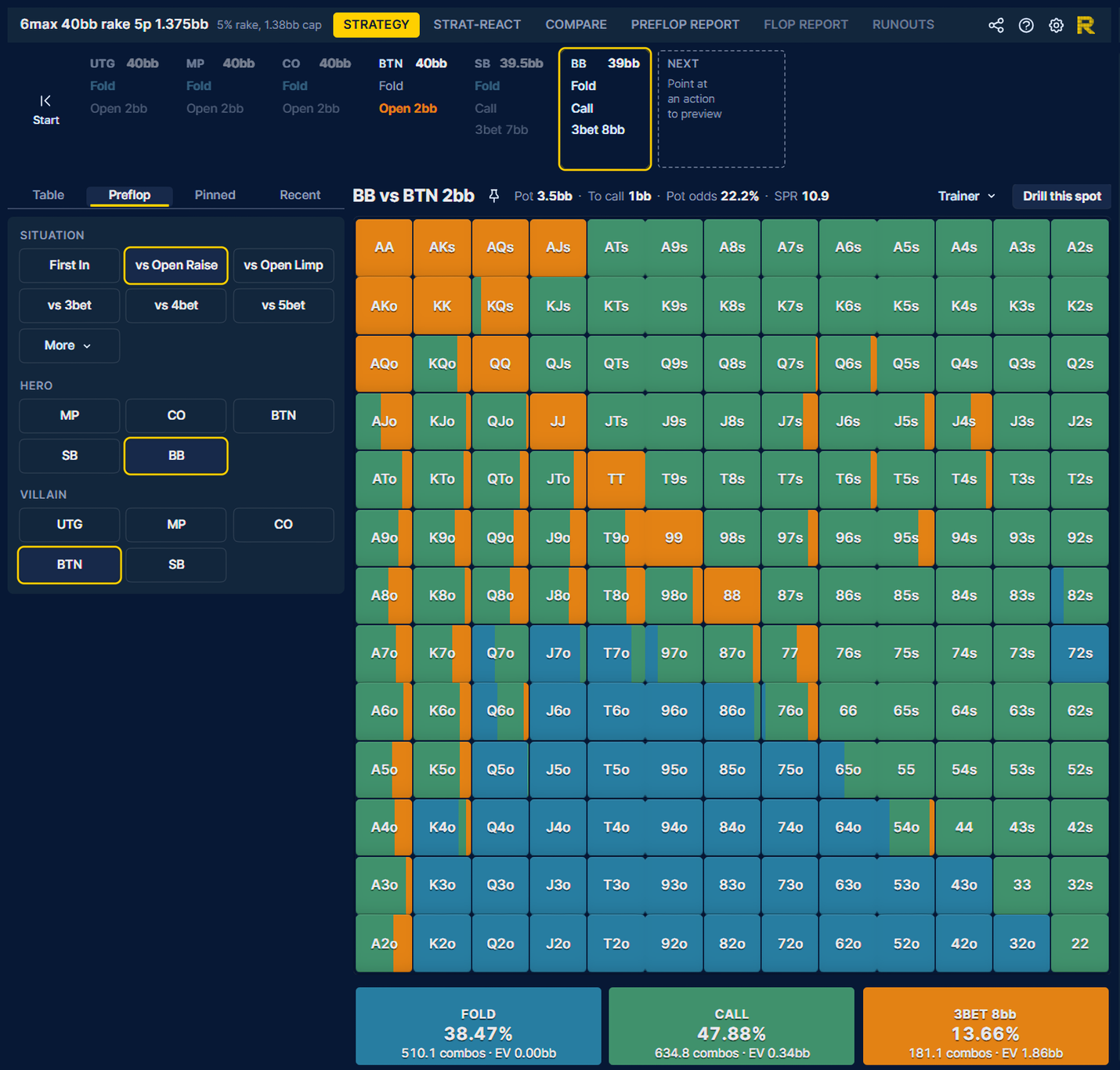
Move through the game tree
The hand runs across the top navigation bar. Start takes you back to the first decision. After it comes one card per decision: the seat, its stack and its actions. The action the line took is filled in its colour, and the card you are on has a gold ring.
- Click an action on the current card to play it.
- Click the seat on an earlier card to go back to that decision. The line you walked stays on the game tree navigation bar, dimmed, so you can step forward along it again.
- Your browser's Back and Forward buttons step through the spots you have visited.
Hover preview lets you look ahead without moving. Hover over an action and the decision it leads to appears at the end of the line. Hover over an action in the preview to look further, or click it to go there. You can switch it off in Display settings.
See how to navigate the game tree in the Online Range Viewer on the RangeConverter YouTube channel.
On a keyboard, ← and → walk the hand, 1 to 9 pick an action, Enter plays it and S jumps to the other player's last decision and back. Press ? for the full list.
Jump to any spot with Quick select
Quick select takes you to a named spot in two or three clicks.
- Preflop: pick a situation, such as First In, vs Open Raise, vs 3bet or vs Squeeze, then Hero and Villain. In a multiway pot, pick every villain. On a heads-up sim the situation is enough.
- Flop (Pro): pick a line from limped, single-raised, 3bet or 4bet pots, then a flop. Flop report at the top of the list opens the line's Flop report.
- Pinned: press the pin beside a spot's name to save it here. You can rename a pin.
- Recent: the last 20 spots you looked at in the sim.
Clicking a seat on the table picks that player in Quick select.
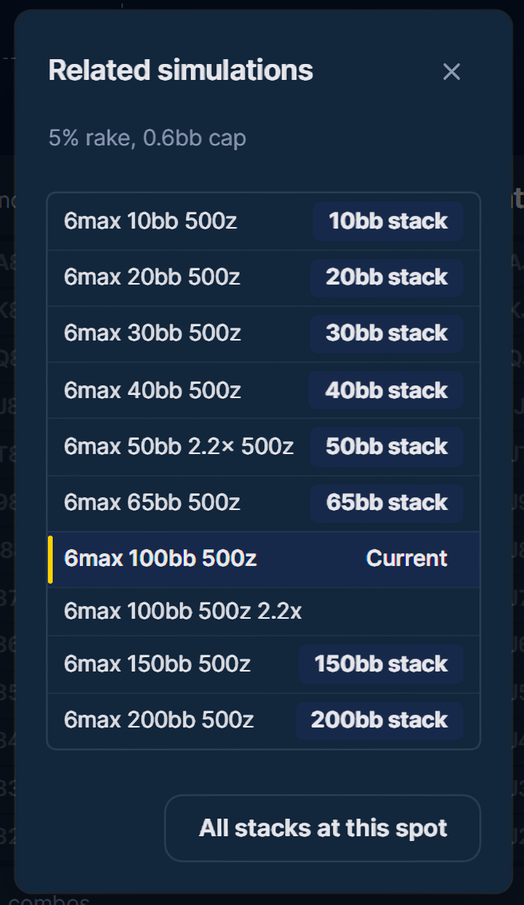
To see the same spot at another stack depth, rake or ante, click the sim's name at the top left. It lists the related sims. All stacks at this spot, at the bottom of that list, opens Compare across every stack depth.
Read the strategy grid
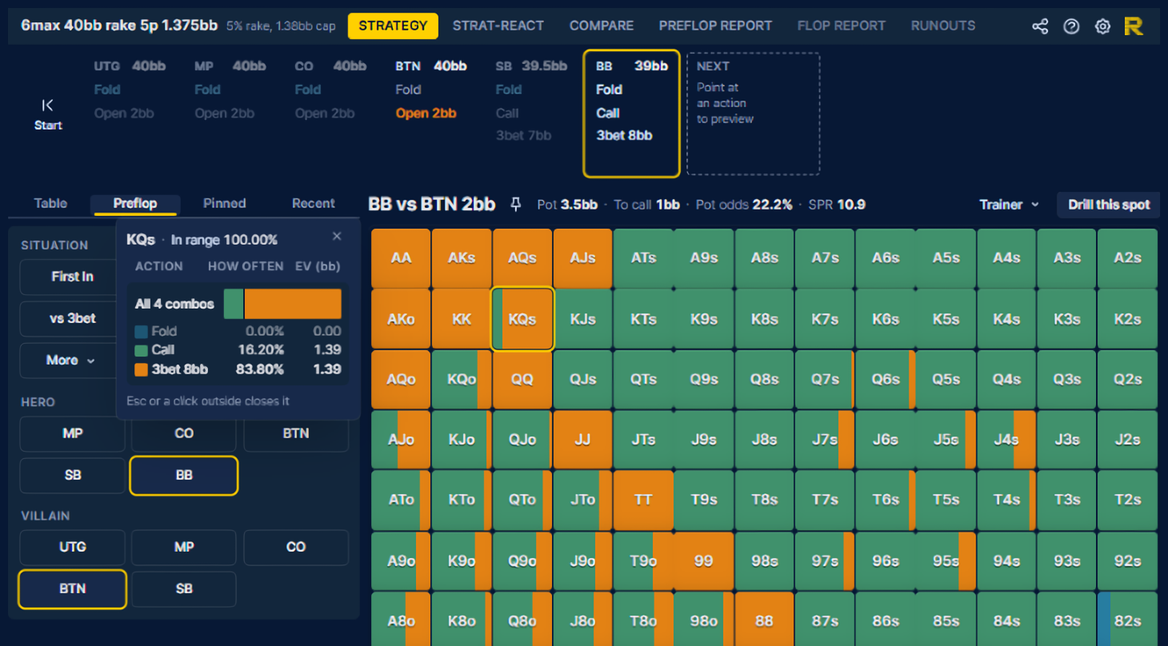
Strategy is where the viewer opens. Each square is a starting hand, coloured by how often the solver plays each action. A square in one colour is a pure strategy. A dimmed square is a hand that never reaches the spot.
Above the grid, the spot's name says who acts and what they face, such as "UTG first in" or "BB vs BTN 2.5bb". Beside it you see the pot, the amount to call, the pot odds and the SPR.
Hover over a square to see the hand's exact mix and the EV of each action. Click it to keep the pop-up open.
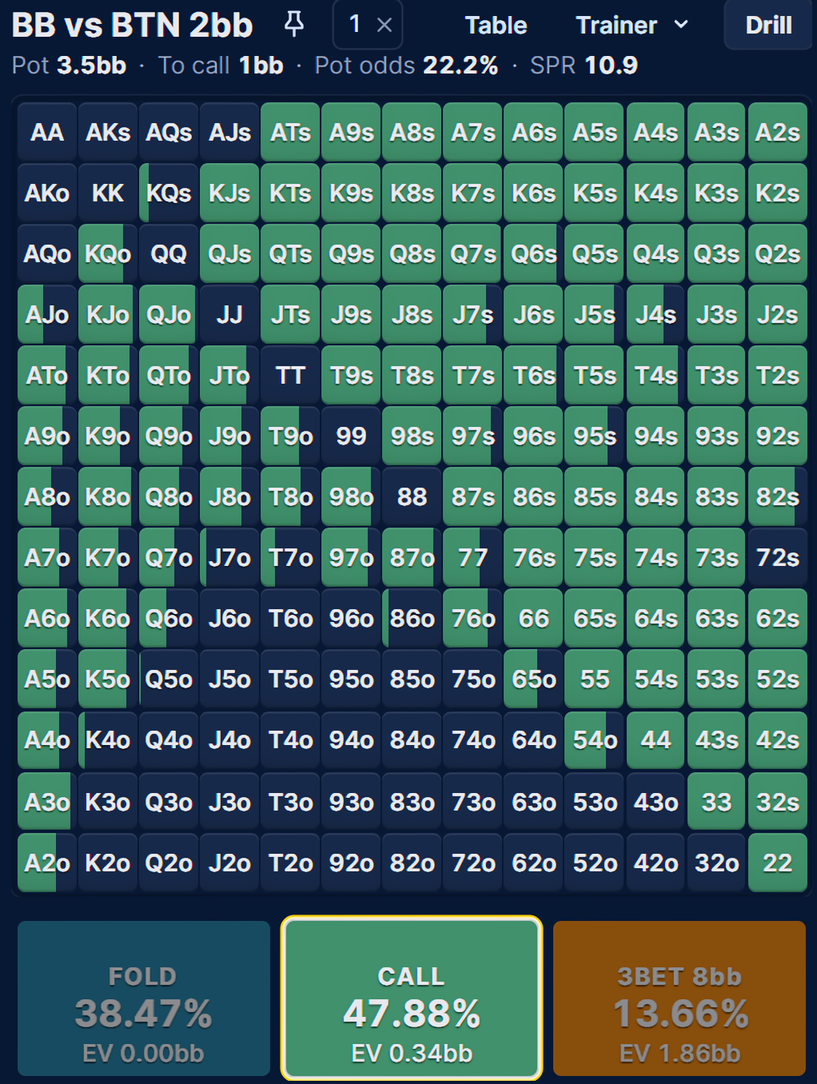
Under the grid, one button per action shows how often the range takes it, with its combos and EV. Click a button to see only the hands that take that action. Click it again to see every hand.
Ranges, Range vs range and Breakdown
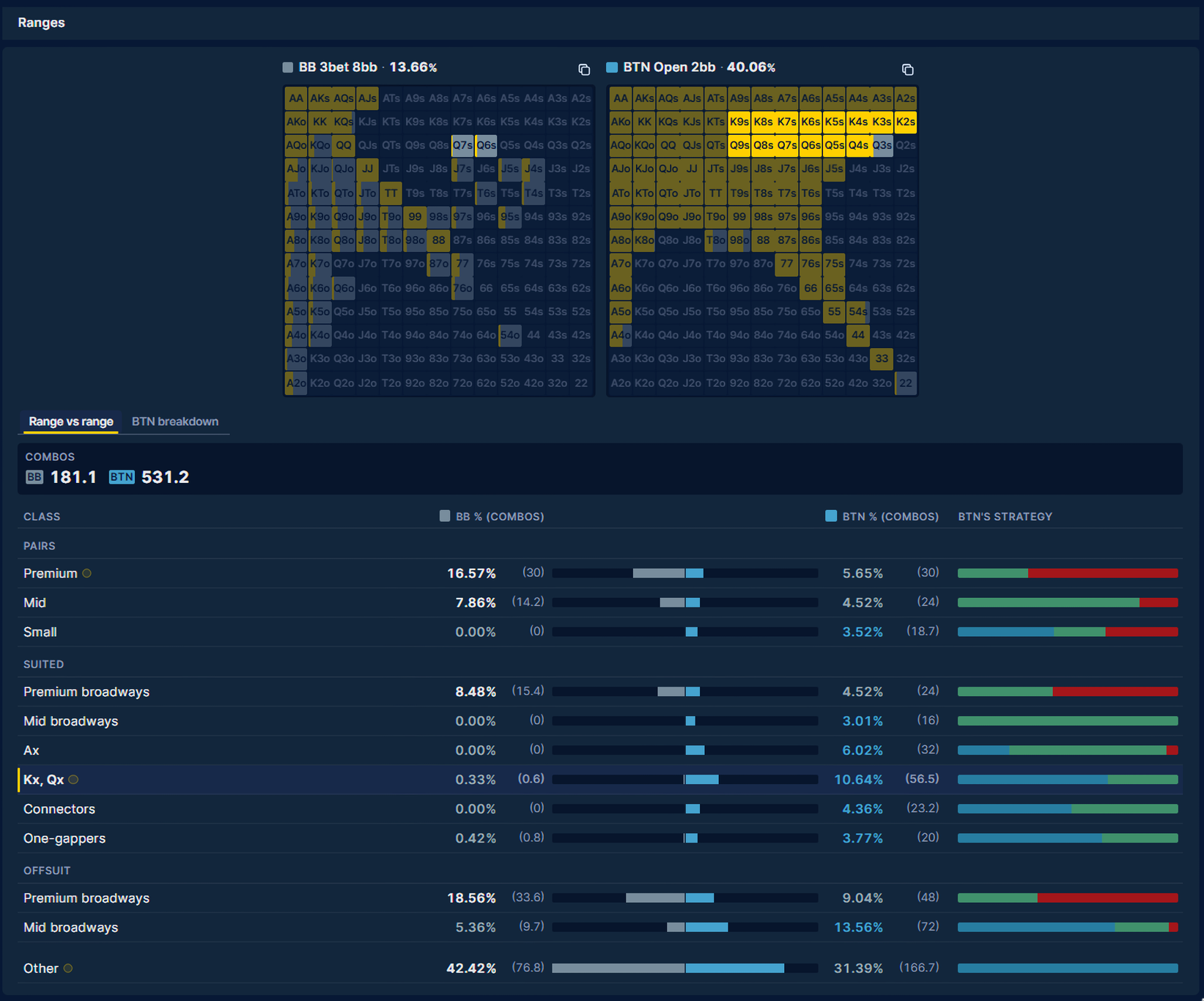
The Ranges panel on the right shows both players' ranges at the spot as two grids. Hover over a hand to see its combos and weights.
Under the grids there are two tabs:
- Range vs range compares the two ranges by hand class, such as premium pairs, suited connectors or offsuit broadways. In each row the brighter number shows which player holds more of their range in that class. Hover over a class to highlight its hands, and click to keep them highlighted.
- Breakdown (for example UTG breakdown) shows how the player to act plays each hand class and what share of the range it makes up. Click a class to highlight its hands on the strategy grid.
Each range grid has a copy icon. It copies the range as solver text, each hand with its weight, so you can paste it into your own solver as a fixed range.
Strat-React: how each hand answers a raise
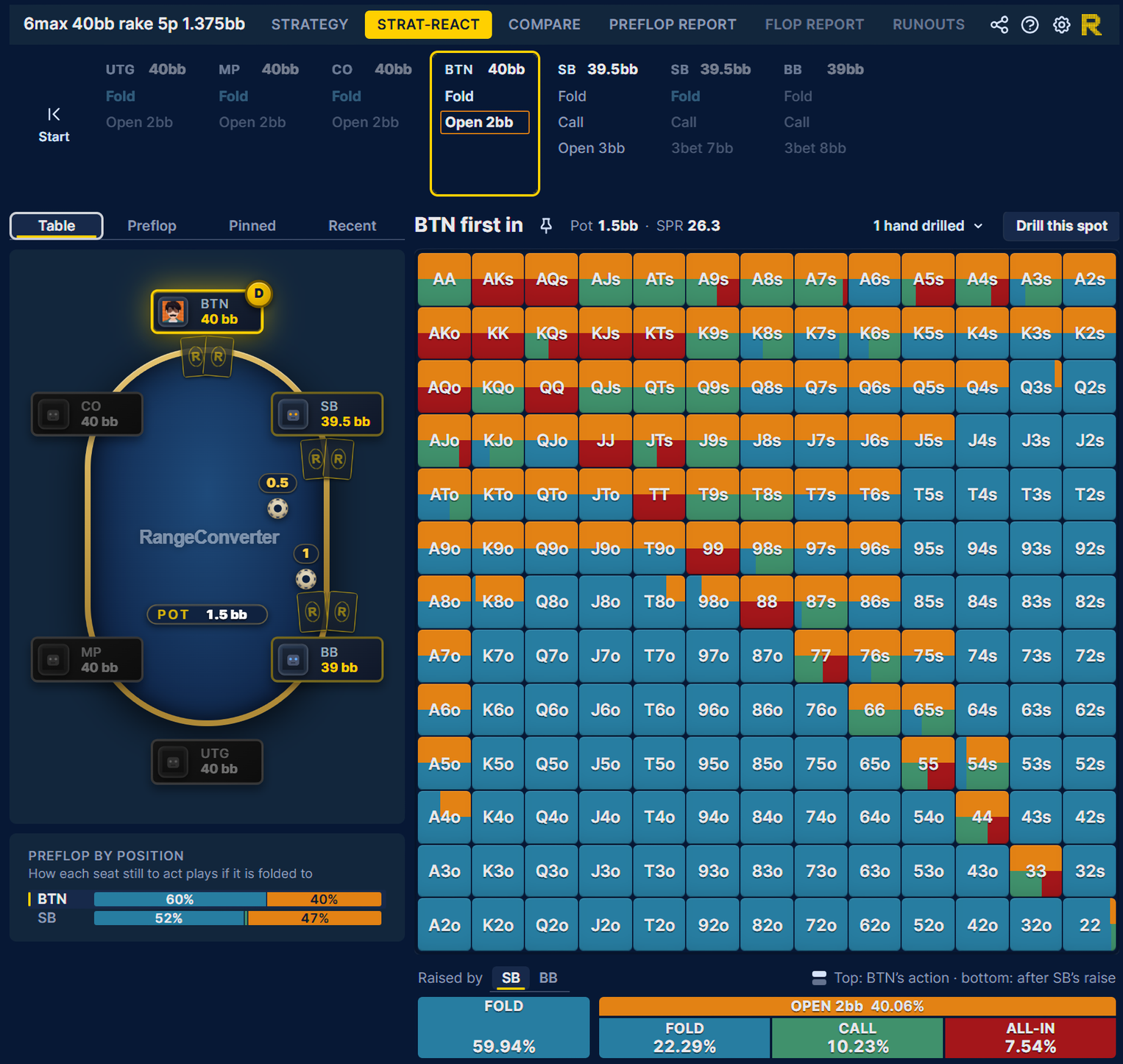
Strat-React shows how each hand answers a raise. Open on the BTN and it shows, hand by hand, what your opens do when the BB 3bets.
Every square splits in two. The top is what the hand does here. Where someone can raise after it, the bottom shows how the hand answers: fold, call or raise again. Raised by picks the raiser and the size, and one tile per line gives its share of the range. Hover over an action tile to see its hands on the grid.
Strat-React is a computer view, before the flop on every plan and postflop on Pro.
Find out how the strategy react feature can make your poker training more effective on the RangeConverter YouTube channel.
Compare spots side by side
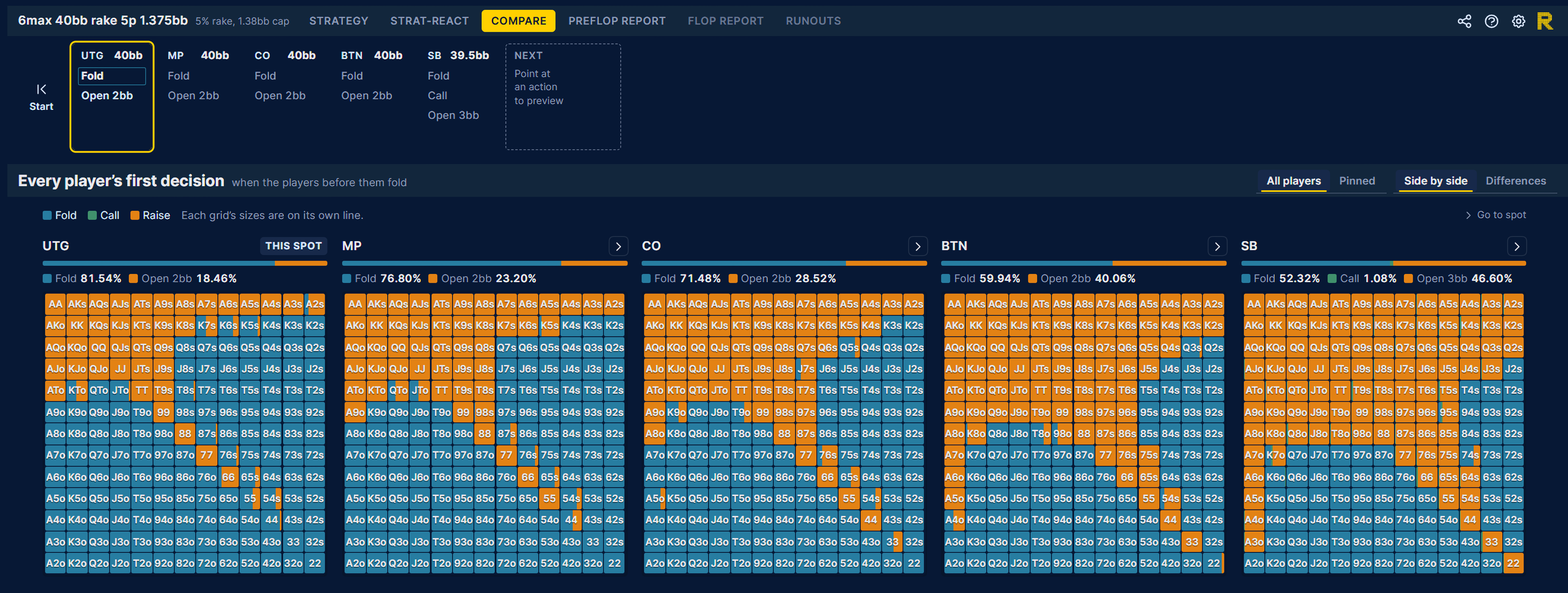
Compare puts one grid per spot side by side, before the flop:
- All players: every player facing the same action, such as every seat's first decision.
- All stacks: this spot at every stack depth of the related sims.
- Pinned: the preflop spots you pinned.
Side by side shows each spot's own strategy. Differences colours each hand by what it plays more often than at the reference spot, so the changes stand out. Go to spot opens that spot in the viewer.
See how to visualise poker ranges for all players and across different stack sizes, or the short version: look up poker ranges for all players and across different stack sizes.
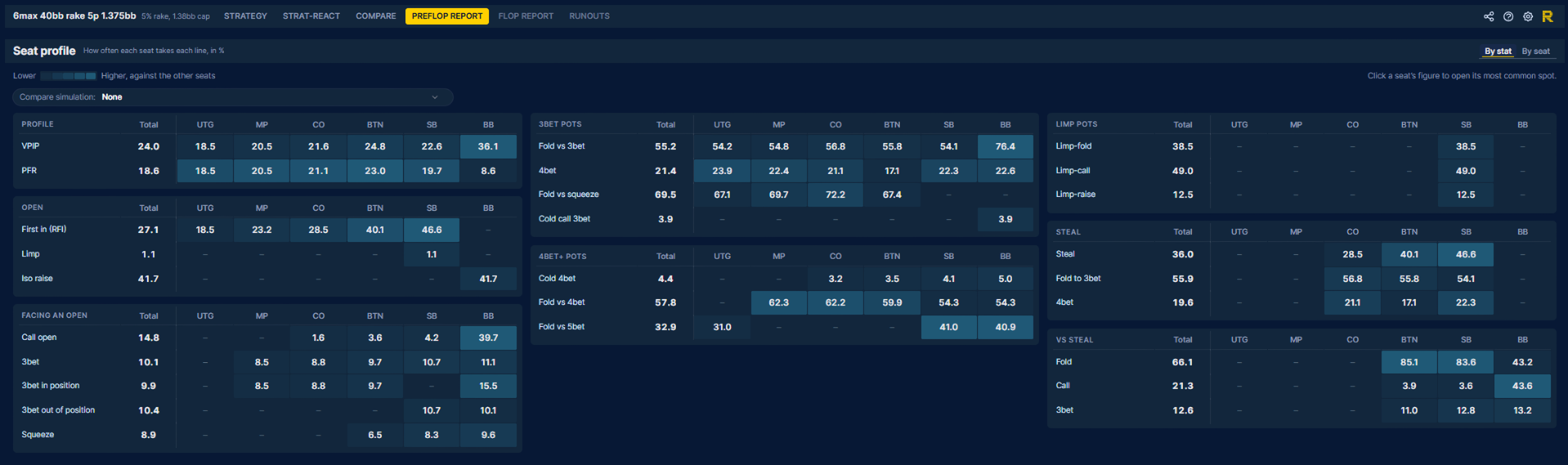
Preflop report
The Preflop report lays out the preflop stats of the whole sim, seat by seat: VPIP and PFR, first in, open jams, limps, calling an open, 3bets, squeezes, folding to 3bets and 4bets, steals and steal defence, and more.
By stat lines the seats up stat by stat. By seat gives each seat's full profile. Click a figure to open that seat's most common spot.
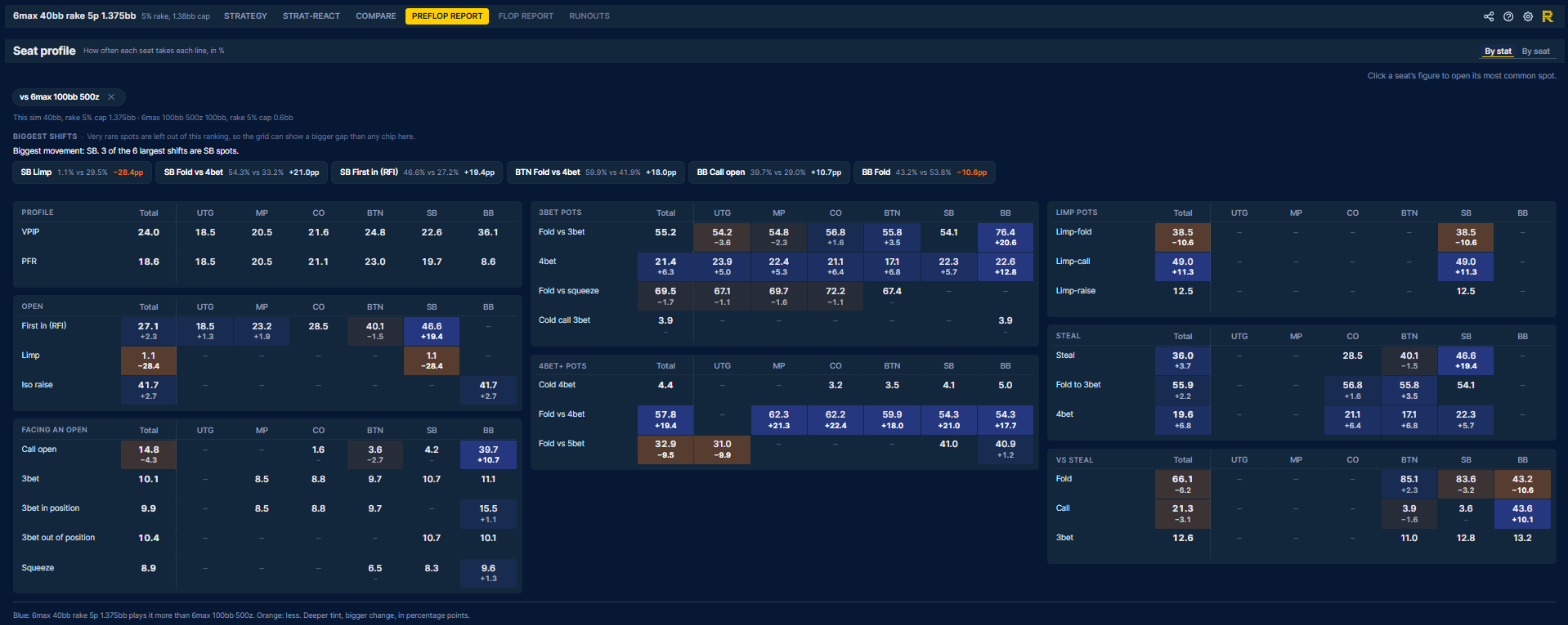
Compare simulation sets another sim beside the one you are on and tints every figure by how much the two differ: blue where the sim you are on plays it more, orange where it plays it less, and a deeper tint for a bigger change. The biggest shifts are listed on top. Use it to see what rake, stack depth or an ante changes in preflop play.
Postflop study (Pro)
With Pro, the tree carries on past preflop on every sim that includes postflop: 22,100 flops in Hold'em and 7,140 in Short Deck. On Reg these parts stay in view, marked Pro.
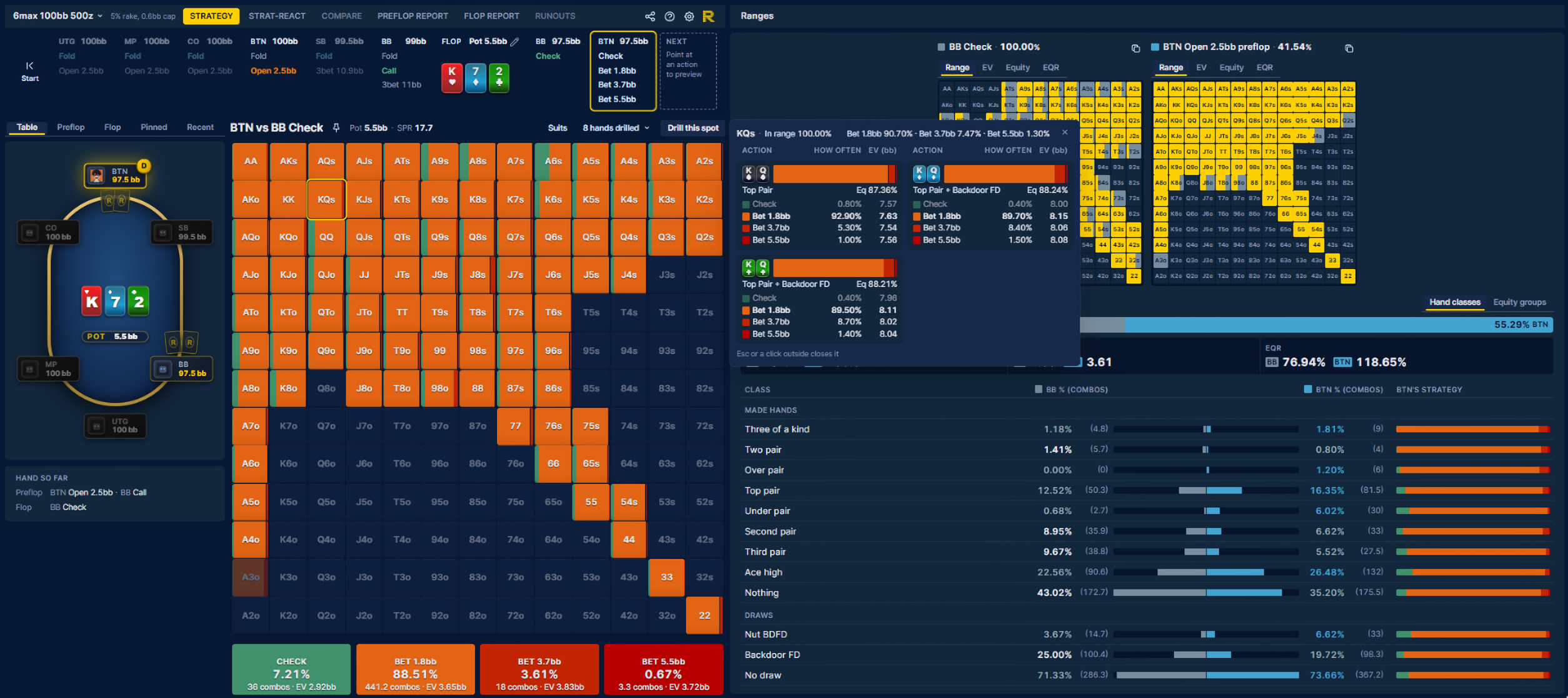
Change the board. A board card opens each street in the game tree navigation bar. Click it to deal another flop, change one card, or pick a different turn or river. Pick the cards, or type the board, such as Kh7d2c, and press Confirm.
Read each combo. After the flop, the pop-up on a square splits the hand into its suit combos. Each one shows its own mix and EV, what it makes, such as "Top Pair + Backdoor Flush Draw", and its equity. Suit buttons above the grid narrow every hand to the suits you pick.
EV, equity and EQR. In a heads-up pot, each range grid switches between Range, EV, Equity and EQR. Range vs range adds both players' equity, EV and EQR, and Breakdown splits the range into made hands, draws or equity groups.
Flop report
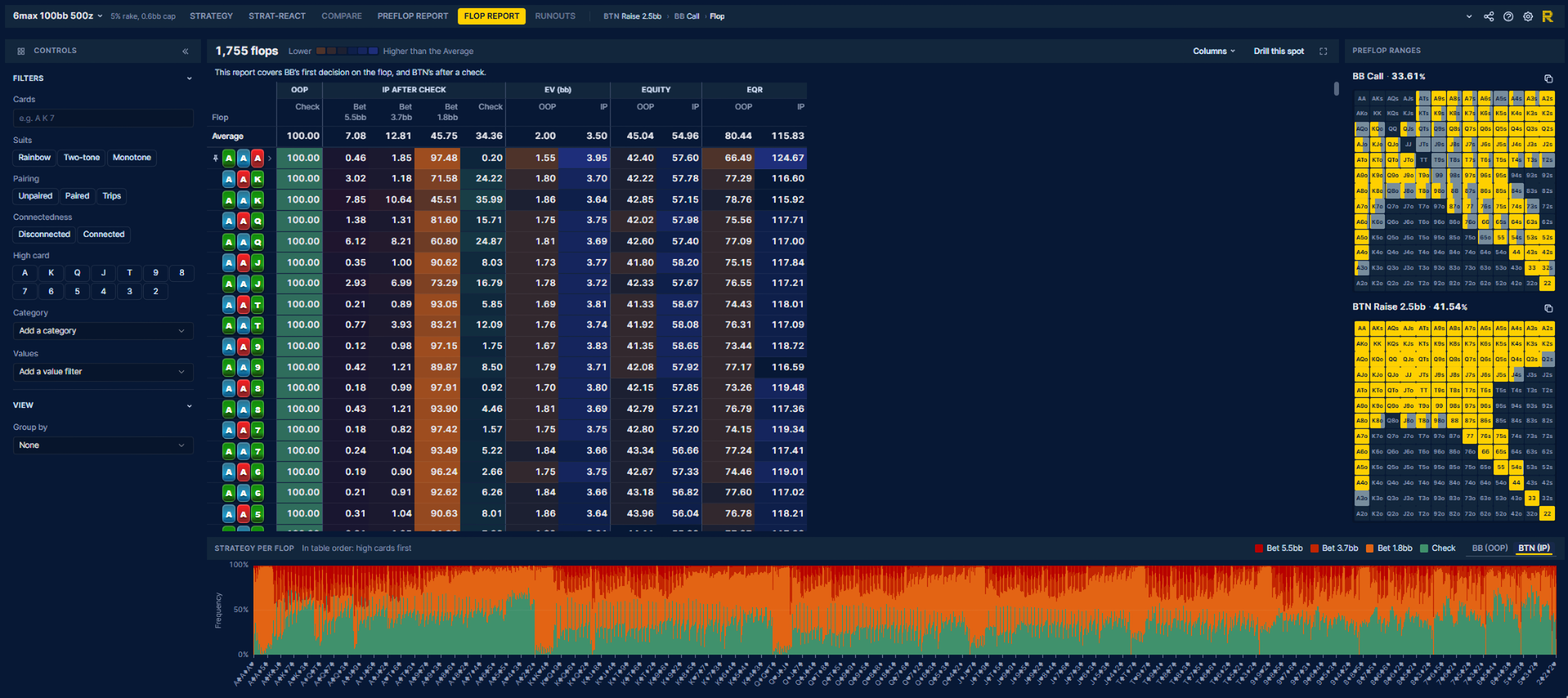
The Flop report, also known as aggregated reports, shows the strategy on every flop of a line in one table. In Hold'em it lists 1,755 flops. That is all 22,100 flops reduced to the ones that play differently: flops that differ only by their suits, such as A♠K♠2♥ and A♥K♥2♠, share one row. Each row is one flop, with each action's frequency and both players' EV, equity and EQR. An Average row at the top is weighted by how often each flop comes.
- Click a column to sort by it, and pin up to five flops to the top.
- Columns picks what the table shows.
- Filters narrow the flops by cards, suits, pairing, connectedness, high card, board category or any value, such as IP EV or OOP check-raise frequency. Combine several to find exactly the flops you want.
- Group by folds similar flops into one row with their average: by suits, pairing, texture, high card or category.
- The OOP and IP after check switch picks whose decision the report shows.
Under the table, Strategy per flop shows the same flops as bars. Click a flop or a bar to open it. Preflop ranges in the right-hand panel shows both players' ranges coming into the flop, each with a copy button. The report covers heads-up pots, at the first decision on the flop and after a check.
Read more: Aggregated reports: the best way to study postflop strategy, 6max 100bb 500z flop strategy with aggregated reports and the aggregated reports and filters update. Or watch how to use the aggregated reports feature.
Runouts
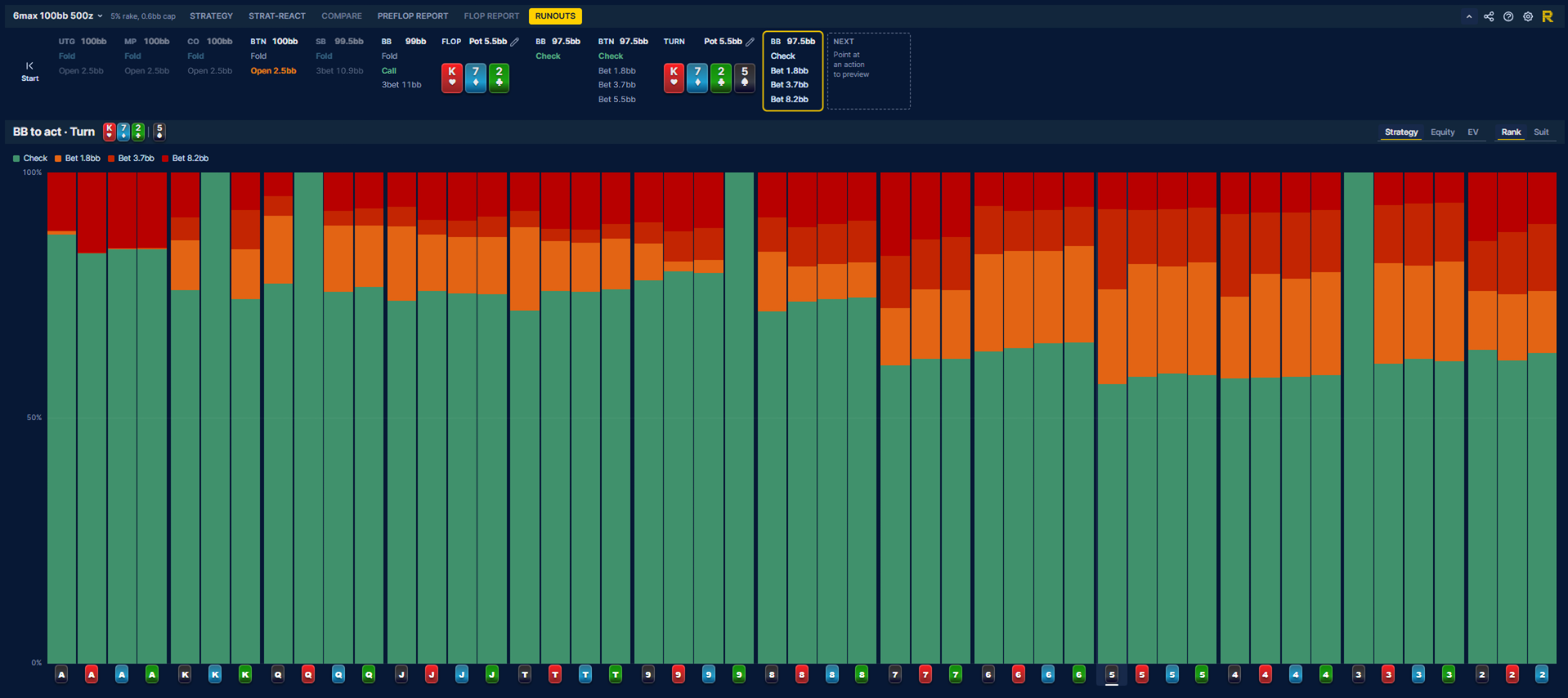
On the turn or river, Runouts shows every card that could come on this street, one bar each, and how the strategy changes with it. Switch the bars between Strategy, Equity and EV, sort them by rank or by suit, and click a bar to open that card. If a runout has not been worked out yet, press Work out the runouts and give it a minute or two.
See how to use the poker histogram and heat maps in the Online Range Viewer. [The video shows the old flop histogram and turn/river heatmap, which Strategy per flop and Runouts replace.]
Drill this spot in the GTO Poker Trainer
Drill this spot, the button above the grid, opens the GTO Poker Trainer on the spot you are studying and deals you hands from it. After the flop it deals the board on screen. On a computer the Trainer opens in a new tab. On a phone it opens in the same tab.
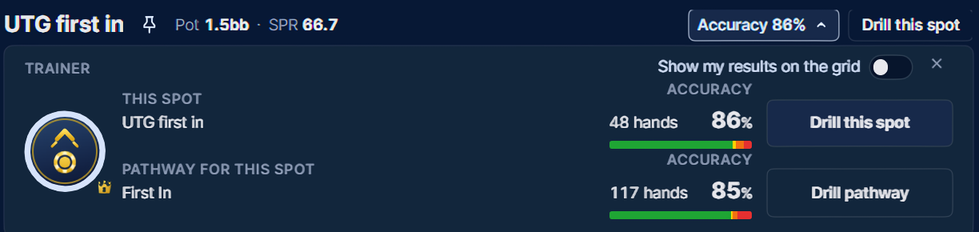
Beside the button sits your Trainer record at this spot. Once you have 10 graded hands there, it shows your accuracy, such as "Accuracy 94%". Click it to see your record at the spot and on its pathway, with Drill pathway and Show my results on the grid. That repaints the grid with your own Trainer results, hand by hand, so you can see exactly which hands you get wrong.
Find out more about the GTO Poker Trainer.
Share a spot and change the display
Copy link to this spot, at the top right, copies a link to what is on your screen: the spot, the board, the view and any hand you kept open. Send it to a friend, your coach or your team. Whoever opens it needs an account with access to that sim.
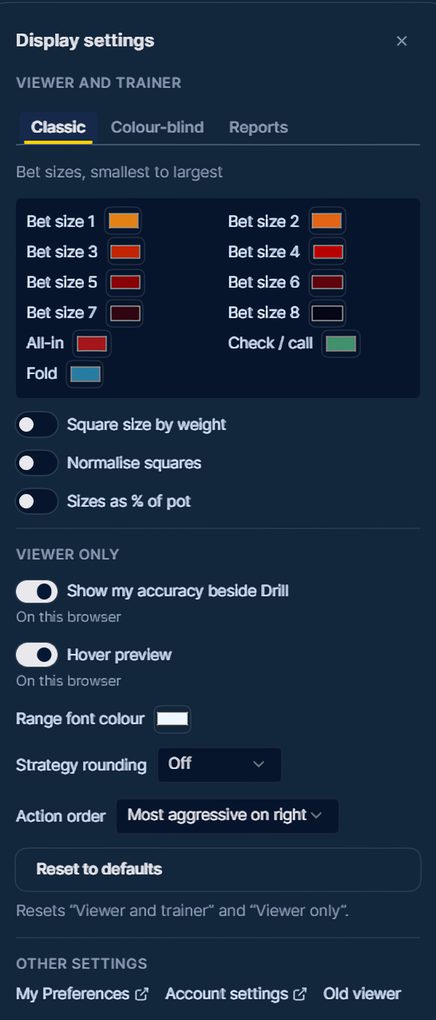
The gear opens Display settings. Changes show straight away:
- Palette: Classic, Colour-blind or Reports, plus a colour for each bet size, all-in, check or call, and fold.
- Square size by weight and Normalise squares draw each square by its share of the range.
- Sizes as % of pot shows bet sizes as a share of the pot instead of big blinds.
- Strategy rounding rounds each mix to the nearest 10%, 25%, 50% or 100%. Randomise gives each hand one action, picked by its frequency, which turns the grid into a test rather than an answer.
- Action order, Range font colour, Show my accuracy beside Drill and Hover preview.
The palette, the two square settings and sizes as % of pot also apply in the GTO Poker Trainer, so both always look the same.
The Range Viewer on your phone
On a phone the grid fills the screen. The hand sits at the top, and four buttons sit at the bottom: Back, Ranges, Drill and More, which holds Compare, the reports and Runouts. Tap a hand to see its mix and combos. Quick select sits in the header, and the menu at the top right holds Copy link, Display settings and Help.
Strat-React, the table and Hover preview are for bigger screens.
Prefer the old viewer?
The old viewer is still there. Open Display settings, go to Other settings and choose Old viewer. It opens at the spot you are on. Switch to new viewer, in the old page's Settings, brings you back. Your browser remembers your choice.
Start studying optimal Hold'em and Short Deck strategy and train GTO ranges today! Subscribe to Reg or Pro for Hold'em cash, MTT, Spins or Short Deck now.